What makes Ha Long Bay special
Ha Long Bay is the limestone karst seascape on half of Vietnam's tourism posters: nearly 2,000 islands and islets rising out of jade-green water, most of them uninhabited, some hollowed into caves you can walk or kayak into. It's a UNESCO World Heritage Site and the anchor of any Vietnam itinerary that takes in the north. The catch is that "Ha Long Bay" is really three separate bodies of water sharing the same geology, and which one you book into changes the trip more than most people realise before they arrive.
Ha Long Bay, Lan Ha Bay or Bai Tu Long: which one
| Bay | Character | Best for |
|---|---|---|
| Ha Long Bay | The original, UNESCO-listed core, with the most famous view and the heaviest boat traffic | A day trip, if that's all the time you have |
| Lan Ha Bay | Same karst scenery off Cat Ba island, fewer boats, the best kayaking and swimming | Most solo travellers, and our default recommendation |
| Bai Tu Long Bay | Further north east, the quietest of the three, but far fewer cruise options | Travellers who want solitude over convenience and don't mind a shorter list of boats to choose from |
That's the short version. For the fuller breakdown, including which cruise routes actually sail where, see our Ha Long Bay vs Lan Ha Bay guide.
Cat Ba island: the base for Lan Ha Bay
Cat Ba is the largest island in the archipelago, and it's where most Lan Ha Bay cruises start and end, either from Cat Ba town itself or from a pier reached over the sea bridge from Hai Phong. More than half the island is Cat Ba National Park, with trails running from a couple of hours to a full day through limestone forest; adult entry is 160,000 VND on Hai Phong's fee schedule from 1 January 2026 (80,000 to 120,000 VND on some routes), though some 2026 guides still quote 80,000 VND, so check at the gate. It's worth arranging a guide locally for the longer trails rather than turning up unprepared. Lan Ha Bay belongs to Hai Phong city, while Ha Long and Bai Tu Long bays are in Quang Ninh province. Cat Ba town has a small strip of hostels, cafés and dive and kayak shops, plus a few beaches below the town if you want a swim without booking a boat at all.
Day cruise or overnight cruise
Day cruises leave from Ha Long City's Tuan Chau pier or from Cat Ba, usually running five to seven hours and covering one cave plus a viewpoint stop. They're reasonable if you're short on time, but the trade-off is a long day of travel for a short window actually on the water, no kayaking session at golden hour, and no night at anchor.
The standard choice, and the one most backpacker-age travellers book, is a 2 day, 1 night (2D1N) cruise. A typical run: pick-up from your Hanoi hotel around 8am, boarding by early afternoon, an afternoon of kayaking, swimming and one cave, dinner on board, a quiet night anchored in the bay, then a morning activity before disembarking around midday. Budget, backpacker-grade boats run roughly USD 105 to 160 per person for 2D1N; mid-range boats run USD 145 to 250. Meals, a kayak or bamboo-boat session, one cave and the bay's sightseeing fee are normally included in the price; drinks and crew tips aren't.
Kayaking, the caves and floating villages
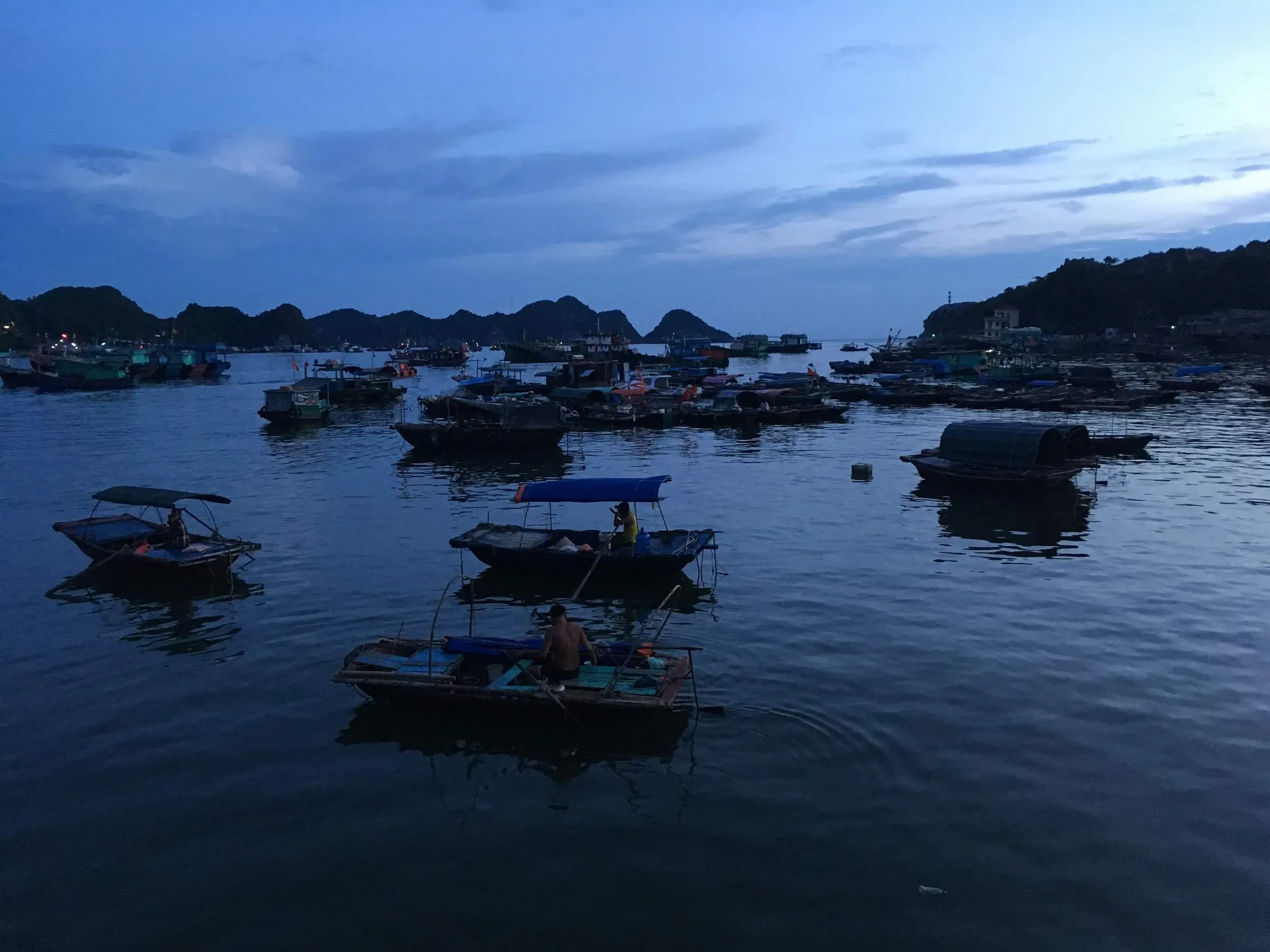
Kayaking is the main reason to pick Lan Ha over Ha Long Bay itself: sessions usually run 45 minutes to an hour, paddling between limestone islets with far less boat wash to deal with than in the main bay. Most Lan Ha cruises also stop at a floating fishing village, commonly Cai Beo or Viet Hai, for a look at a way of life that predates the tourist boats by generations.
Ha Long Bay's classic route stops at Sung Sot Cave (Surprise Cave), the biggest cave in the bay at more than 12,000 square metres, with around 500 metres of walkways across two chambers, and sometimes Thien Cung Cave on Dau Go Island, reached by roughly 90 stone steps up a cliffside path. Lan Ha itineraries usually include one cave along the route too, though it's rarely named until you're on board, since the exact stop depends on tides and the operator.
How to pick a boat operator safely
A fatal accident in July 2025, when an overnight boat capsized in a sudden storm near Ha Long Bay's Dau Go cave, led Quang Ninh to tighten the rules for tourist boats in Ha Long Bay. Boats there now carry AIS tracking and VHF radio, and face unannounced inspections, with any boat that fails pulled from service. On 27 February 2026 a wooden-hulled boat caught fire in the bay with 41 people aboard, all evacuated safely, and the deputy prime minister ordered every one of the 508 cruise ships on Ha Long Bay inspected. A provincial plan to replace wooden hulls with steel by 2030 was still a draft when reported in November 2024. We found no official statement that the same checks apply to Lan Ha Bay, which Hai Phong runs. A few things are worth checking before you book:
- Ask whether the boat carries AIS and VHF, and whether it's had a recent safety inspection; a legitimate operator should answer this without hesitation.
- Prefer a boat with a steel hull, or one you can confirm has been recently inspected, over the cheapest wooden-hull boat sold on the street in Hanoi's Old Quarter.
- Check the written cancellation and refund policy before you pay a deposit, especially if you're travelling June to September (see below).
- Book through an established agent rather than a walk-in tout, and get the boat name and cabin type confirmed in writing.
We haven't named specific cruise operators here, because boats and their standards change often. Check the points above for whichever operator you're considering, at the time you book. For wider safety advice on travelling Vietnam solo, see our Vietnam safety guide.
Getting there from Hanoi
Cruise operators typically run their own shuttle from Hanoi's Old Quarter, leaving around 8 to 9am and reaching the pier by late morning: Ha Long Bay's Tuan Chau pier is about 2 to 3 hours by road, and Lan Ha Bay cruises leave from Cat Ba island, about 3 to 4 hours from Hanoi by road and ferry. If you're travelling independently to Cat Ba island rather than joining a cruise straight from Hanoi, a combined bus-and-ferry ticket runs roughly USD 11 to 22 and takes about 3.5 to 5 hours, crossing from Hai Phong by ferry, speedboat or the cable car onto the island. See our Hanoi guide for getting from the city to Ninh Binh, Sapa and Ha Giang too.
Typhoon season and cruise cancellations
The Gulf of Tonkin's typhoon season runs roughly June to October, with the highest risk in July to September; travel in this window and there's a real chance of a cruise suspension of a day or more, ordered by the local authorities rather than by the individual boat when a storm or tropical depression is forecast. On 22 August 2026, for example, tours and overnight stays on Ha Long Bay and Lan Ha Bay were suspended from 7am ahead of Storm Narra, to resume only when the weather was judged safe. Keep your dates flexible around this period if you can, and ask about your operator's rebooking policy before paying anything. Outside typhoon season, January to March can bring fog that softens the views without cancelling cruises outright. If a cancelled cruise would wreck your trip, build the bay into a longer loop rather than making it the one thing everything else depends on, so a lost day here doesn't cost you the rest of the trip.
How long to spend, and which route guide to use
One overnight (2D1N) is enough to say you've properly done Ha Long or Lan Ha Bay; a second night mainly adds more kayaking and swimming time rather than new sights, since the scenery itself doesn't change much from day to day. Most travellers fold the bay into a longer northern loop rather than visiting it on its own: our Northern Vietnam itinerary runs Hanoi, Ninh Binh, Lan Ha Bay and Sapa over 1 week or 10 days, and pairs naturally with Ninh Binh's karst-on-land scenery (see our Ninh Binh guide) if you're routing north to south.



Keep planning
Sort your Vietnam e-visa before you fly, and check Vietnam's best time to visit guide if you're building this around other regions. If mountains rather than water are more your pace, compare with the Ha Giang Loop further north, or see every route on our Vietnam itinerary hub.