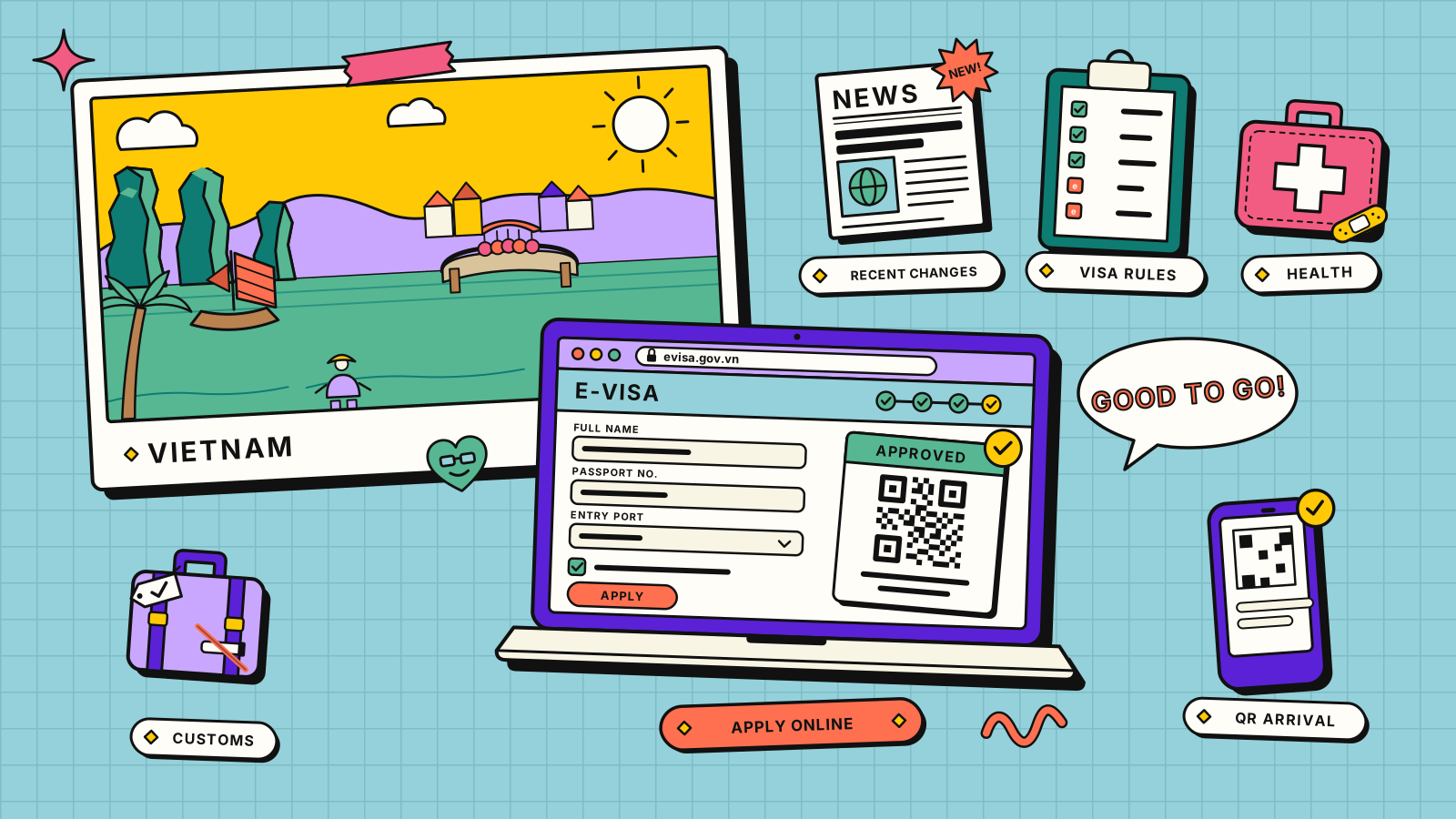
Vietnam changed its entry rules several times in 2025 and 2026, so check the official links below again just before you fly.
This guide covers who needs an e-visa, which website is the real one and what happens at the airport. For a version written for your passport, with flights and packing, pick your country:
- Vietnam from the US
- Vietnam from the UK
- Vietnam from Australia
- Vietnam from Canada
- Vietnam from Europe (Germany, France, Netherlands, Ireland, Spain, Italy, Sweden)
- Vietnam from India
Do I need a visa for Vietnam? Table by nationality
| Passport | Visa needed? | How long | Notes |
|---|---|---|---|
| United Kingdom | No | 45 days | Any purpose. Passport stamp on arrival |
| Germany | No | 45 days | Any purpose |
| France | No | 45 days | Any purpose |
| Spain | No | 45 days | Any purpose |
| Italy | No | 45 days | Any purpose |
| Sweden | No | 45 days | Any purpose |
| Netherlands | No, for tourism | 45 days | Tourism only. Business or other purposes need a visa |
| Ireland | Yes: e-visa | Up to 90 days | Ireland is not on either exemption list |
| United States | Yes: e-visa | Up to 90 days | |
| Canada | Yes: e-visa | Up to 90 days | |
| Australia | Yes: e-visa | Up to 90 days | |
| New Zealand | Yes: e-visa | Up to 90 days | Not on either exemption list |
| India | Yes: e-visa | Up to 90 days |
Ireland catches people out. The Irish Department of Foreign Affairs says all Irish passport holders need a visa.
If you're visa-free but staying longer than 45 days, apply for the e-visa instead. It gives up to 90 days.
Visa-free stays: how the 45 days work
The 45-day exemption comes from two government resolutions. Resolution 44/NQ-CP covers the UK, Germany, France, Spain, Italy and Sweden (plus Denmark, Norway, Finland, Japan, South Korea and Russia) for any purpose, and runs until 14 March 2028. Resolution 229/NQ-CP covers the Netherlands, Belgium, Switzerland, Poland, the Czech Republic and seven other European countries for tourism only, until 14 August 2028.
You get a stamp in your passport on arrival with your exit date. Check that date before you walk away from the desk.
Since August 2023 there's no required gap between visa-free visits, so you can pop over to Laos or Cambodia and come back for another 45 days. Officers still have discretion, though, and people doing repeated "visa runs" report being questioned.
How to apply for the Vietnam e-visa, step by step
The e-visa has been open to every nationality since 15 August 2023.
| Official website | evisa.gov.vn (Vietnam Immigration Department, Ministry of Public Security) |
|---|---|
| Length | Up to 90 days |
| Fee | USD 25 single entry, USD 50 multiple entry |
| Processing | About 3 working days. Allow 1 to 2 weeks, and longer around Tết (Lunar New Year) |
| Refund if refused | None. The portal says the fee is non-refundable if the visa is not granted |
| Entry points | 83 border gates: 17 airports, 27 land crossings and 39 seaports |
If you're only flying in and out, single entry is enough. If you plan to pop over to Laos or Cambodia and come back, pay for multiple entry, because a single-entry e-visa only gets you in once.
These steps follow the portal's own guide, though the button labels can change:
- Go to evisa.gov.vn and choose the option to apply for an e-visa as a foreigner. Read the instructions and tick the two confirmation boxes.
- Upload a portrait photo: 4x6 cm, white background, looking straight at the camera, no glasses, JPG under about 2 MB, taken in the last 6 months.
- Upload a scan or photo of your passport data page. Include the whole page, with your photo and both lines of machine-readable text at the bottom, no glare and no cropped corners. JPG, under about 2 MB. The system reads your details from the passport image and checks that the two photos match, so a blurry scan can get your application rejected.
- Check the details it fills in, and correct anything so it matches your passport exactly, including middle names. Add your intended entry date, single or multiple entry, your entry and exit ports, your address in Vietnam (your first hotel is fine) and the purpose of your visit.
- Check everything, enter the verification code, then pay USD 25 or USD 50 by credit or debit card through the portal's Vietcombank payment gateway. Expect a one-time passcode (OTP) from your bank, so have your phone with you. The portal doesn't list which card brands it takes.
- Save the registration code. You need it to check your status.
- Check your status on the portal's search page using the code, your email and your date of birth. The result is also sent by email. When it's approved, download the e-visa PDF, print it and carry the printout.
Be careful when you choose ports. The UK and Canadian governments both say the e-visa ties you to the ports you select. The 83 gates include Hanoi (HAN), Ho Chi Minh City (SGN), Da Nang (DAD), Cam Ranh for Nha Trang (CXR) and Phu Quoc (PQC). Pick the airport you're actually landing at, and list the one you plan to leave from. Some travellers have left through a different port without trouble, but I wouldn't count on it.
If your e-visa is issued while you're already in Vietnam, you have to leave and re-enter to activate it.
If you get stuck, email foreigners@xuatnhapcanh.gov.vn (applications) or technical_support@immigration.gov.vn (technical problems).
Fake e-visa websites and "visa on arrival" letters
This is where people lose money. Search "Vietnam visa" and the top results are often paid ads for private agencies with official-looking names. They charge around USD 75 to 150 for the same USD 25 visa.
The official site ends in .gov.vn. Watch out for:
- evisagov.vn, which has no dot between "evisa" and "gov". It is not a government domain.
- Sites such as vietnam-visa.com, vietnamvisa.govt.vn and myvietnamvisa.com, which are private agencies.
- "Urgent" 1-day or same-day processing. No agency can legally speed up the official process.
Agencies also sell "visa on arrival approval letters". Visa on arrival still technically exists through a Vietnamese sponsor, but some agencies send group letters listing other travellers' passport details. Use the e-visa instead.
Phu Quoc's 30-day rule
If you fly (or sail) directly to Phu Quoc island from abroad, you can stay up to 30 days without a visa, whatever your nationality. You can't continue to the mainland on it, though. The Irish DFA warns that tourists who fly on from Phu Quoc to Ho Chi Minh City without a visa may be detained.
Vietnam's Ministry of Foreign Affairs lists the Phu Quoc stay as 30 days, and says it also covers travellers who stay in the international transit area of another Vietnamese airport or seaport and then continue to the island. The Irish DFA page still says 15 days, which is the older figure. If you plan to connect through Hanoi or Ho Chi Minh City, ask your airline whether it can check you through to Phu Quoc, because you mustn't pass through immigration on the mainland.
The pre-arrival QR declaration
New for 2026, Vietnam has a digital arrival form at prearrival.immigration.gov.vn. It's free. You fill it in no more than 3 days before you land (or at the airport) and get a QR code to show at immigration.
It started at Ho Chi Minh City's Tan Son Nhat airport on 15 April 2026 and reached Phu Quoc on 1 June and Hanoi in June. The Immigration Department now lists Noi Bai (Hanoi), Tan Son Nhat, Da Nang, Nha Trang and Phu Quoc, and the US Embassy says it is expanding to all airports.
Whether it's compulsory still isn't clear. The US Embassy calls it mandatory for all international passengers without a Vietnamese passport, and the Irish DFA says it's required at Ho Chi Minh City and Phu Quoc. The Singapore Embassy in Hanoi (page updated 30 September 2026) says visitors are encouraged and "strongly advised" to do it. The UK and Canadian advice pages say it's encouraged but not mandatory. Check the latest wording before you fly.
I'd fill it in before you fly. It's free and quick, and without it you'll queue longer at immigration (reports mention up to 40 minutes). Some airlines and staff treat it as mandatory anyway. Only use the .gov.vn address. Sites like vietnamprearrival.com are private and charge a fee.
Transit passengers don't need it.
Passport, onward ticket and arrival
Your passport must:
- Be valid for at least 6 months after the day you arrive. Canada words it as 6 months after your expected departure, so use that stricter reading to be safe.
- Have at least 2 blank pages.
- Be undamaged. The UK Foreign Office says British travellers have been refused entry with damaged passports.
Enter and leave on the same passport. A visa in an expired passport isn't valid, and Irish passport cards can't be used.
An onward ticket isn't a formal rule, and immigration rarely asks for one. Check-in is where it bites: airlines commonly ask for proof that you'll leave within your permitted stay (45 days, or your e-visa end date), and they can refuse to board you without it.
When you land:
- Have your pre-arrival QR code ready.
- At immigration, show your passport, your printed e-visa if you need one, the QR code, and possibly your onward ticket. Visa-free travellers get a stamp with their exit date.
- Collect your bags and go through customs. Use the green channel if you have nothing to declare, and the red channel if you're carrying cash over the limits, goods over the allowances or controlled medicines.
Your hotel registers every visitor with the local police, which is why it asks for your passport.
Extensions and overstays
Tourist visas can't be extended, and for tourists e-visas and visa-free stays generally can't be extended from inside the country either. Agencies advertise "extensions", but those rely on a Vietnamese sponsoring organisation; you can't just do it yourself. If you want more time, the usual route is to leave and come back on a new e-visa or exemption.
Overstaying got more expensive under Decree 282/2025, in force since 15 December 2025:
| Overstay | Fine |
|---|---|
| Under 16 days | VND 500,000 to 2 million |
| 16 to under 30 days | VND 5 to 10 million |
| 30 to under 60 days | VND 10 to 15 million |
| 60 to under 90 days | VND 15 to 20 million |
| 90 to under 180 days | VND 20 to 25 million |
| 180 days to under 1 year | VND 25 to 30 million |
| 1 year or more | VND 30 to 40 million |
On top of the fine, the authorities can order deportation, depending on how serious the case is.
Health
- Yellow fever. You only need a certificate if you're arriving from a country with yellow fever risk, which doesn't include the UK, US, Europe, Australia, New Zealand or India.
- Vaccines. The CDC recommends routine vaccines plus hepatitis A, hepatitis B and typhoid, and sometimes Japanese encephalitis or rabies. See a travel clinic at least 8 weeks before you leave.
- Malaria and dengue. No malaria risk in the big cities or the Mekong and Red River deltas. There is some risk in rural forested provinces, including parts of the Central Highlands. Dengue is found everywhere, so bring repellent.
- Health declaration. Decree 165/2026 created one from 1 July 2026, but the Ministry of Health says it only applies if activated for a specific outbreak.
- Insurance. It isn't a legal entry requirement, but get it anyway. The UK and Irish governments both advise cover that includes medical evacuation, because complex cases can mean a transfer to Bangkok or Singapore.
- Emergency numbers: 115 ambulance, 113 police, 114 fire.
Customs and what not to bring
Vapes are banned. Since 1 January 2025 it has been illegal to import, possess or use e-cigarettes and heated tobacco (IQOS-type devices included). Since 31 December 2025 users can be fined VND 3 to 5 million and the device destroyed. Customs confiscate them on arrival, so leave them at home.
Medicines. Controlled medicines (for anxiety, depression, insomnia or ADHD, and strong painkillers) are limited to 7 days' supply. Carry a doctor's letter in English with your name, age, the medicine, the dose, and the doctor's signature and address. Keep prescriptions in your hand luggage with a copy of the prescription, and declare medicines worth over USD 100.
Drugs, CBD included. Vietnam's drug laws are severe and include the death penalty. A positive drug test can lead to charges even if you took the drug before you arrived.
Drones. Strictly, you need an import licence and a flight permit from the Ministry of National Defence, applied for at least 2 weeks ahead. Rules were tightened on 5 November 2025. Customs may hold an undeclared drone until you leave. Don't bring one unless you have a permit.
Cash. Declare more than USD 5,000 (or the equivalent) or more than VND 15 million.
Duty-free allowances (Decree 134/2016, unchanged by the August 2026 duty-free rules): alcohol is one of 1.5 litres of spirits (20% or stronger), or 2 litres of drinks under 20%, or 3 litres of beer. Tobacco is one of 200 cigarettes, 20 cigars or 250 g of loose tobacco. Other personal goods are allowed up to VND 10 million in total. Under-18s get no alcohol or tobacco allowance. Gold jewellery of 300 g or more must be declared.
Weapons, explosives, fireworks, pornography, "anti-state" material and antiques without an export permit are also banned.
Driving and the 1968 permit
Vietnam only accepts the 1968 Vienna Convention International Driving Permit, carried with your home licence, and the licence needs to cover motorbikes for you to ride one. British permits are the 1968 type. Permits from the US, Canada, Australia, New Zealand, Ireland and India are the 1949 type and aren't valid here. Riding without one means fines, an impounded bike and insurance that probably won't pay out. You avoid the whole problem by riding pillion with a licensed driver. There's a full breakdown by country in our Ha Giang Loop guide.
Money, plugs and SIM cards
Money. Vietnam uses the dong (VND). Visa and Mastercard are widely accepted in cities, hotels and bigger restaurants; elsewhere it's mostly cash. Only change money at official, signposted counters, because changing it anywhere else is illegal. ATMs usually give VND 2 to 10 million a time. Fees vary by bank: 2026 guides report VPBank charging foreign cards nothing and most other banks about VND 20,000 to 55,000 a withdrawal, but these change often, so check the fee on screen before you confirm. Your own bank may add its own charge. When you leave, you can change up to USD 500 worth of dong back into dollars.
Plugs. 220 V, 50 Hz. Sockets are Type A (flat US pins), Type C (the two-pin Europlug) and Type F. Type A is more common in the south and Type C in the north. Bring a universal adapter. Anything that only runs on 120 V needs a converter.
SIM and eSIM. You need your passport to buy a local SIM, and airport kiosks set it up in minutes. Rules in force since 15 April 2026 (Circular 08/2026) add a face check to mobile subscriber verification, and foreigners registering with a passport do it in person at the network's counter. Official guidance doesn't spell out how this works at airport kiosks, so allow a little extra time. Buy a travel eSIM before you fly and you skip local registration completely.
More on what to pack is in our Southeast Asia packing list.
Recent changes: a timeline
| Date | What changed |
|---|---|
| 15 Aug 2023 | Visa-free stays extended from 15 to 45 days. E-visa extended from 30 to 90 days and opened to all nationalities, at USD 25 or 50. The 30-day gap between visa-free visits was dropped |
| 1 Jan 2025 | Vape and heated tobacco ban in force. New road traffic law and higher fines for unlicensed riding |
| 15 Mar 2025 | 45-day exemption for the UK, Germany, France, Spain, Italy, Sweden and others renewed to 14 March 2028 |
| 15 Aug 2025 | 45 days visa-free for tourism for the Netherlands, Belgium, Switzerland and nine other European countries, to 14 August 2028 |
| 5 Nov 2025 | Tighter drone rules |
| 2 Dec 2025 | E-visa entry points increased from 42 to 83 |
| 15 Dec 2025 | Higher overstay fines (Decree 282/2025), with deportation possible as an extra penalty |
| 31 Dec 2025 | VND 3 to 5 million fines for using a vape |
| 15 Apr 2026 | Pre-arrival QR declaration starts in Ho Chi Minh City. Biometric checks for new SIMs |
| Jun 2026 | Pre-arrival declaration reaches Phu Quoc (1 June) and Hanoi. Da Nang and Nha Trang are now on the Immigration Department's list |
| 1 Jul 2026 | Health declaration framework (not routinely applied) |
| 1 Aug 2026 | Bamboo Airways stops all scheduled flights. Domestic options are now Vietnam Airlines, Pacific Airlines, VietJet, Vietravel Airlines and Sun PhuQuoc Airways |
| 1 Dec 2026 | Long Thanh, the new Ho Chi Minh City airport about 40 km from the centre, is due to open commercially. Long-haul flights are planned to move there from 28 March 2027. Check which airport is on your ticket |
Travel Vietnam with a small group
Every SoloNomads trip is for travellers aged 18 to 40, and I come along on every one as your Trip Host.