Kanchanaburi is a sober place, and it helps to arrive knowing that. The Death Railway (officially the Thailand-Burma Railway) was built between 1942 and 1943 by Allied prisoners of war and conscripted Asian labourers, under Japanese command, to supply the occupation of Burma. An estimated 90,000 or more labourers and over 12,000 Allied POWs died during construction, mostly from disease, starvation and exhaustion rather than combat. The bridge, the railway and the museums here exist to remember that, not to entertain, and most visitors go quiet once they're standing on the tracks.
What makes Kanchanaburi worth the trip
It's the closest place to Bangkok where you can walk a real stretch of the Death Railway and see, in plain terms, what it cost. That's the reason most people come. Erawan's waterfall is a genuine draw in its own right for anyone who wants a swim and a hike alongside the history, but it isn't why Kanchanaburi first got put on the map.
Where to go within Kanchanaburi
The Bridge on the River Kwai
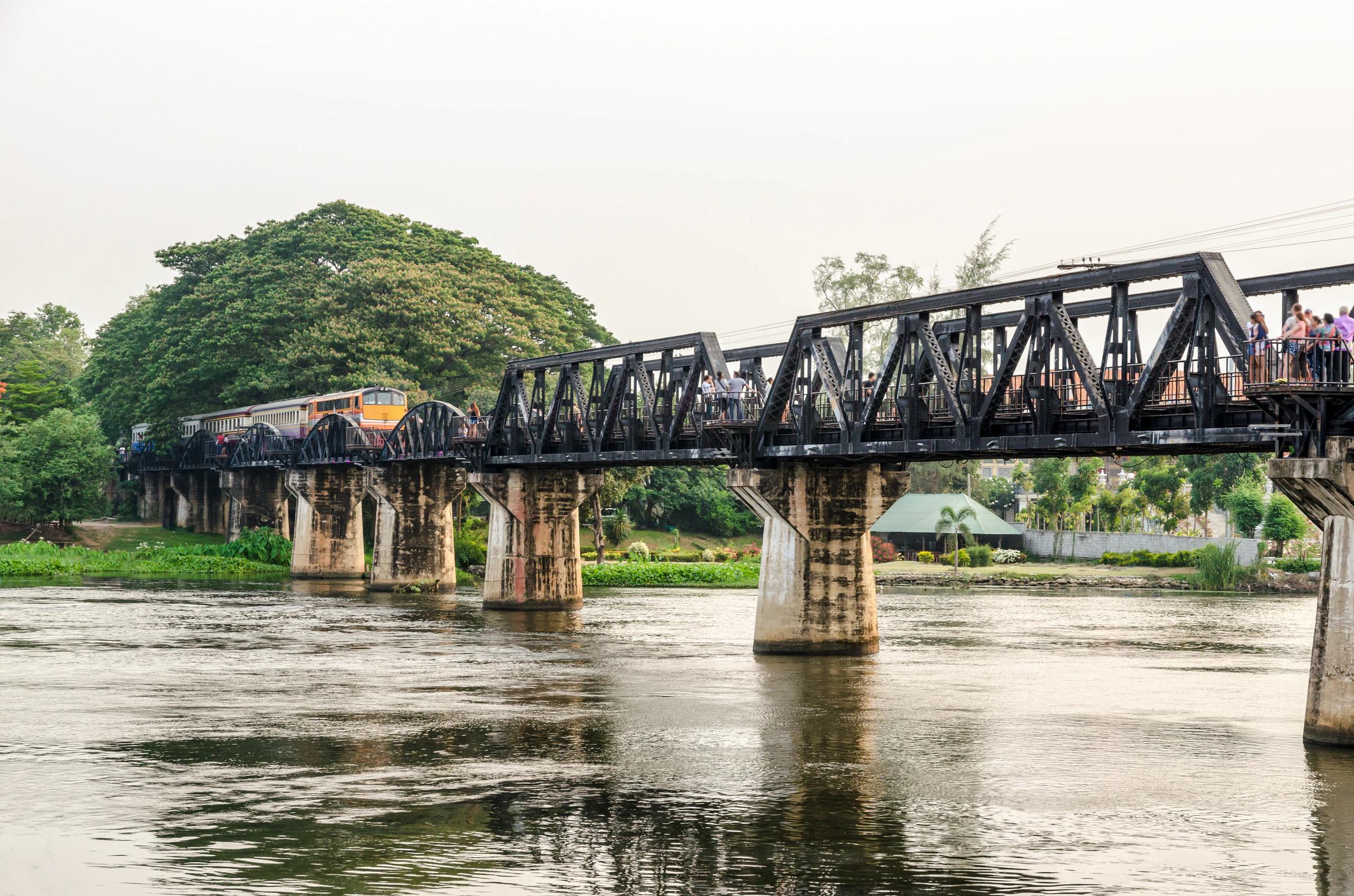
The steel bridge that gives the town its fame is still a working railway bridge, and you can walk across its curved sections between passing trains (there's a warning bell and a timed gap). It was rebuilt after Allied bombing destroyed the original central spans in 1945; two of the original curved trusses survive, and the rest are square postwar replacements, worth knowing before you go looking for a bridge that's entirely "historic". Walking it is free. A small night market and light show run along the riverfront most evenings.
The Death Railway to Nam Tok, over the Wang Pho viaduct
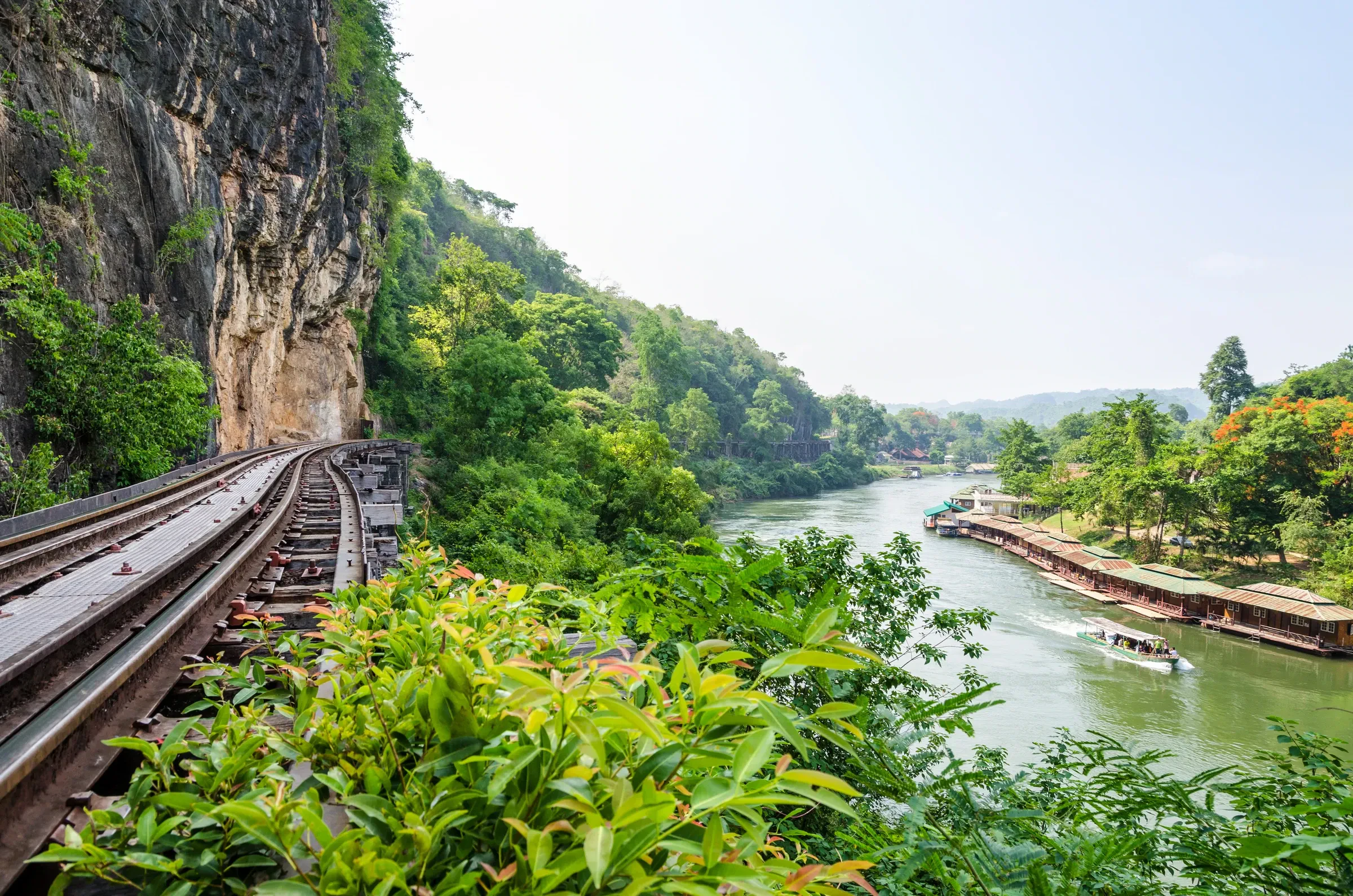
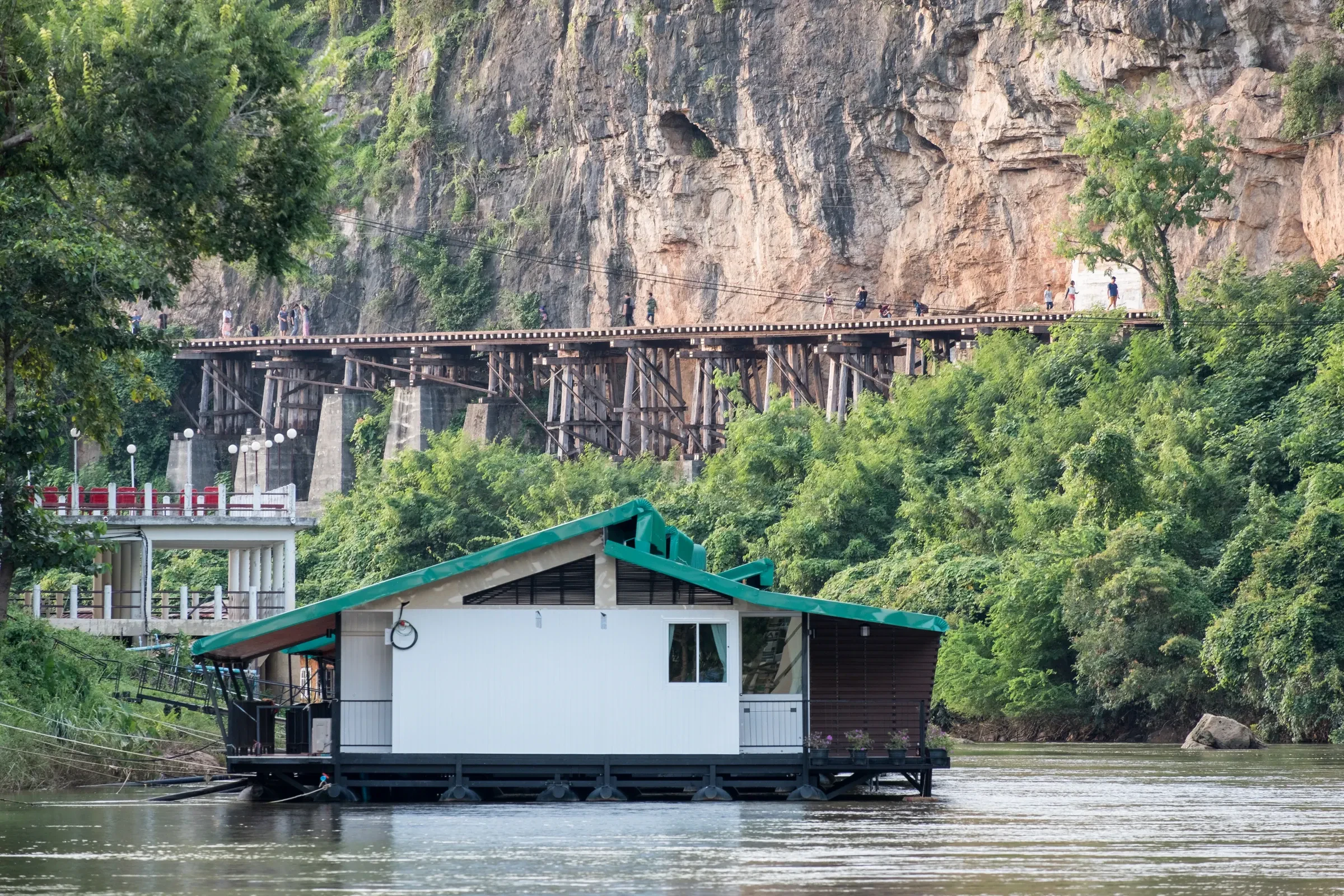
The section of line still in use runs from Kanchanaburi to Nam Tok, and the best part of it is a roughly 400 m wooden viaduct at Wang Pho, built into a cliff face above the river. The train slows right down here, which is when everyone leans for the window. Only a few local trains a day cover this stretch, and timetables have shifted over the years, so confirm times at Kanchanaburi station. Foreigners pay a flat fare on this line (reported as 100 baht), and tickets are bought at the station on the day, not online.
JEATH War Museum and the Thailand-Burma Railway Centre
Two different museums, worth telling apart. The JEATH museum (the name is an acronym of the countries involved: Japan, England, Australia and America, Thailand, Holland) is a smaller, older-style museum built along a bamboo hut modelled on a POW barracks, with photographs and salvaged objects. The Thailand-Burma Railway Centre, a short walk from the war cemetery, is a newer museum with a well-researched exhibition on how the railway was built and who built it, and the better starting point if you only have time for one. Both charge a modest entry fee, paid at the door.
Kanchanaburi War Cemetery and Chungkai War Cemetery
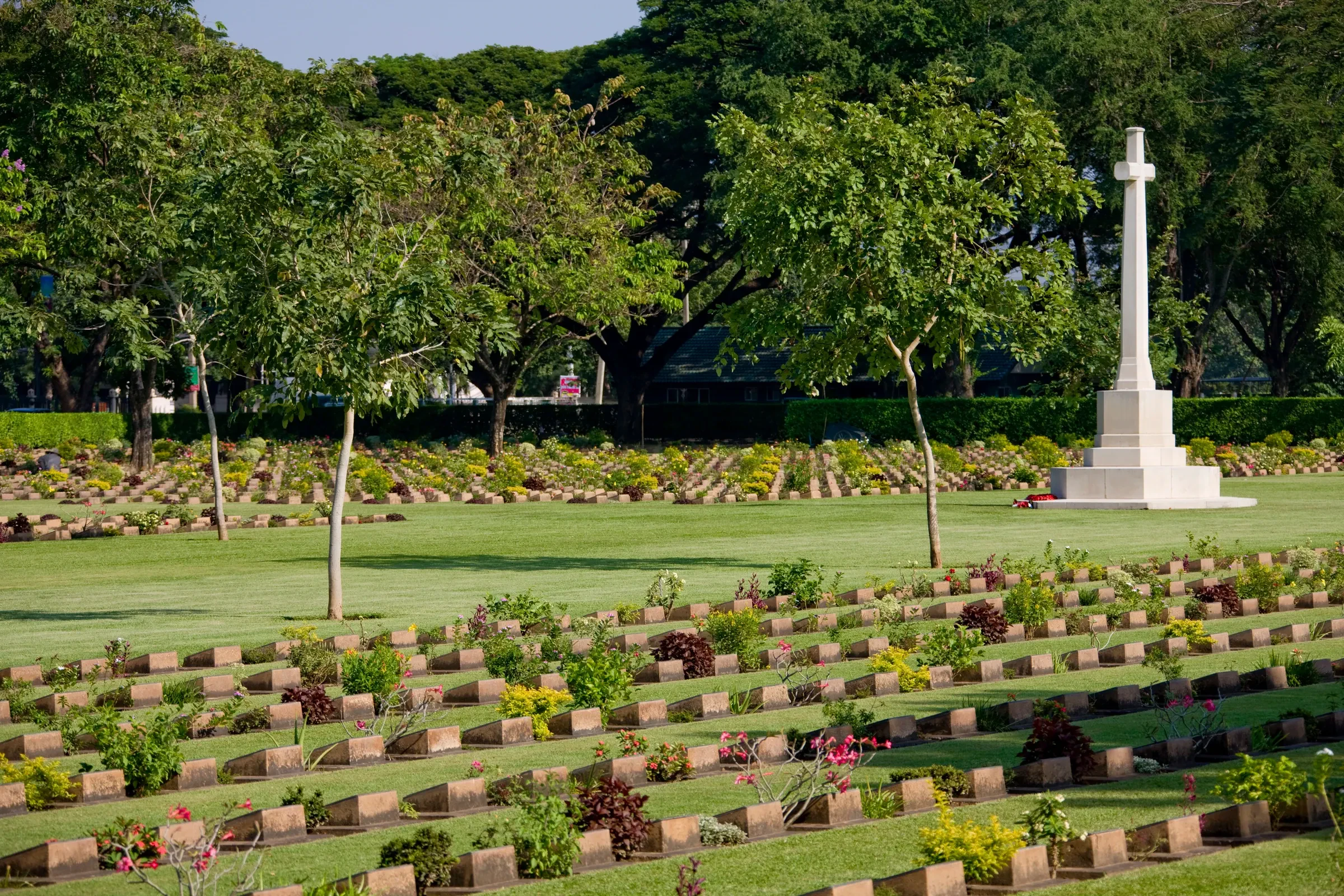
Kanchanaburi War Cemetery, in the middle of town opposite the railway centre, holds over 6,000 Allied war graves, maintained by the Commonwealth War Graves Commission. Chungkai War Cemetery, a smaller site across the river, is quieter and gets far fewer visitors. Both are free to enter and well kept. Opening hours are shorter at weekends, so check the Commonwealth War Graves Commission listing before you go, and treat them as you would any war cemetery, which is to say quietly.
Hellfire Pass memorial
About 80 km further out, an hour by car or 1.5 to 2 hours by bus, Hellfire Pass is the deepest rock cutting on the railway, dug largely by hand under brutal conditions. An Australian-funded interpretive centre sits above it, and a walking trail drops down into the cutting itself and follows a stretch of the old railbed. It's free to enter, with donations welcomed, and the centre is open daily from 9am to 4pm. It closes on a few days a year, including Songkran (13 to 15 April), 5 December, 24 to 27 December, New Year's Eve and New Year's Day, and for annual maintenance in May. The walk to the cutting is an easy 45 minutes to an hour, with a longer 2.6 km trail beyond it. It's arguably the most affecting stop on a Kanchanaburi day out, precisely because so little has been added to it.
Erawan Falls and Erawan National Park
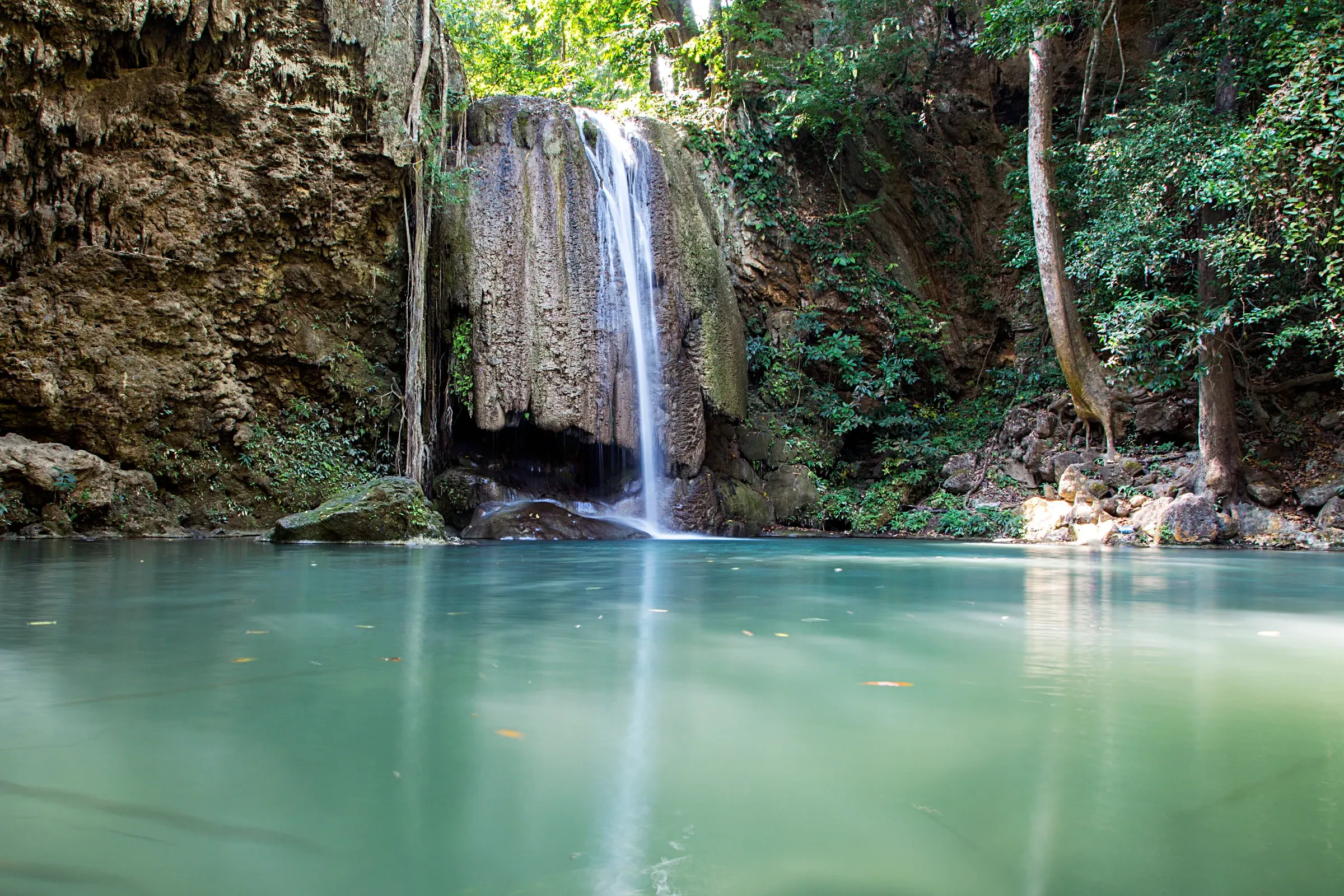
Erawan Falls has seven tiers climbing away from the park entrance, each with its own pool. The lower tiers are an easy, family-friendly walk, while the upper ones need a proper hike over slippery rock (water shoes help). Swimming is allowed in most pools when conditions are safe, and fish nibble at your feet in a few of them, which catches most people off guard the first time. Foreign adults pay 300 baht at the gate, so bring cash, and the park is open 8am to 4:30pm. You can't always count on all seven tiers being open: the upper levels sometimes close after heavy rain or for maintenance, and the park stops admitting new visitors well before its printed closing time, so go in the morning. It can also shut completely in the dry season: it closed to visitors on 21 April 2026 because of forest fires and haze.
Raft houses on the river
A handful of guesthouses and resorts around Kanchanaburi and further upriver near Sai Yok are built as floating rooms, moored to the riverbed rather than genuinely drifting. They range from simple bamboo rooms with no electricity to more comfortable floating villas, and a night on one is the main reason to turn Kanchanaburi into an overnight rather than a day trip. Book ahead in high season, since rooms are limited and the well-known ones fill up.
Things to do
- Walk the Bridge on the River Kwai and time it so a train crosses while you're there
- Ride the local train from Kanchanaburi to Nam Tok for the Wang Pho viaduct
- Spend an hour at the Thailand-Burma Railway Centre before the war cemetery opposite it
- Walk down into the cutting at Hellfire Pass
- Swim at Erawan Falls' lower tiers, or hike to the top if you have the time and footwear
- Spend a night on a raft house if you're staying over
We don't recommend elephant riding or Tiger Temple-style animal attractions, some of which still operate in this area. The original Tiger Temple was closed after the authorities removed its tigers. Several venues here also advertise themselves as elephant sanctuaries. We can't check their welfare claims, so we don't name or recommend any, and we'd rather send you to the railway, the falls and the cemeteries instead.
What to eat
Look for kung phao (grilled river prawns, a local speciality thanks to the river running through town) at restaurants along the water, and khao niew mamuang (mango sticky rice) from roadside stalls when mangoes are in season. Away from the tourist strip, ordinary noodle shops and rice-and-curry stalls around the market are cheap and reliable.
Best time to visit
November to February is coolest and driest, and the most comfortable for the Hellfire Pass walk and a full climb up Erawan's tiers. March to May is hot and dry, and forest fires and haze can close Erawan in April. June to October brings the monsoon's short, heavy afternoon downpours, which can swell Erawan's pools and occasionally close the upper tiers. See our Thailand best time to visit guide for the wider picture.
Getting there from Bangkok
Train from Thonburi (Bangkok Noi) station, on the far side of the river from central Bangkok, is the slow, scenic and cheapest option: two ordinary trains a day, taking around 2.5 hours, with tickets bought on the day at the station rather than in advance. It's a real local train rather than a tourist service, so expect basic fan-cooled carriages and no reserved seats.
Bus or minivan from Bangkok's Mo Chit or Sai Tai Mai (southern) terminals is faster and more frequent, at roughly 2 to 2.5 hours depending on traffic, and better if you want to arrive at a set time rather than around the timetable of two daily trains. Vans are quicker but more cramped; buses have more room.
Most people who only want Kanchanaburi for a day book a private or shared day tour from Bangkok that packages the bridge, a short Death Railway ride and Erawan Falls into one trip, since getting between the sites independently on public transport in a single day is tight. If you're staying overnight, the DIY route by train or bus is easy enough, and you can get around Kanchanaburi itself by songthaew, rented scooter or bicycle.
How long to spend, and which route to use
A well-organised day covers the bridge, one Death Railway ride and either the museums or Erawan Falls, not comfortably both. An overnight adds room for Hellfire Pass, the full climb up Erawan's tiers and a night on a raft house, without the day feeling rushed. Kanchanaburi works as a side trip from Bangkok on its own, or alongside Ayutthaya if you have a longer stay in the capital. See the Bangkok guide for getting in and out of the city, and our Thailand itinerary guide for where Bangkok side trips fit into a longer route.
Kanchanaburi pairs naturally with a short Bangkok stay: see things to do in Bangkok, where to stay in the Bangkok hostels guide, and how the wider country fits together in our Thailand backpacking guide.