In 2026 India brought in an online arrival card and a health form, raised the price of the long visa and changed its permit rules. All of that is below. For your own passport, see the pages for the UK, the US, Australia, Canada or Europe.
Who needs a visa
Everyone covered here needs a visa or an OCI (Overseas Citizen of India) card. Ireland's foreign ministry warns that travellers who arrive without one will be refused entry and will probably be detained. Visa on arrival is only for nationals of Japan, South Korea and (if they've held an Indian visa before) the UAE.
All 12 nationalities in the table below can use the e-visa. The exceptions are anyone with a defence, military, security or police background, serving or retired, and holders of official or diplomatic passports. They need a regular visa.
If you hold a Pakistani passport or are of Pakistani origin, the e-visa isn't open to you: the official site says to apply for a regular visa at an Indian mission. The FCDO adds that processing takes much longer for British-Pakistani dual nationals, who must apply on their Pakistani passport.
OCI cardholders don't need a visa but still have to file the e-Arrival card. The e-OCI launched in June 2026, and since 8 July 2026 new OCI cards are issued only in digital form.
e-Tourist visa types and fees by nationality
Most travellers choose between three e-Tourist visas:
- 30 days. Counted from your first arrival. Multiple entry: the official page changed this from double entry in 2026, so older guides are out of date.
- 1 year. Counted from the date it's granted, not from arrival. Multiple entry.
- 5 years. Counted from the date it's granted. Multiple entry.
No e-visa can be extended or converted.
On the 1-year and 5-year visas you can spend up to 180 days in India per calendar year. That is the only stay limit on the official page. Some sites still quote a 90-day cap on each visit, but the official e-Tourist rules don't include one.
Fees from the official table dated 8 September 2026, in US dollars:
| Passport | 30 days (Apr-Jun) | 30 days (Jul-Mar) | 1 year | 5 years |
|---|---|---|---|---|
| United Kingdom | $10 | $25 | $40 | $484 |
| United States | $10 | $25 | $40 | $160 |
| Canada | $10 | $25 | $40 | $200 |
| Australia | $10 | $25 | $40 | $200 |
| New Zealand | $10 | $25 | $40 | $200 |
| Ireland | $10 | $25 | $40 | $200 |
| Germany | $10 | $25 | $40 | $200 |
| France | $10 | $25 | $40 | $200 |
| Netherlands | $10 | $25 | $40 | $200 |
| Spain | $10 | $25 | $40 | $200 |
| Italy | $10 | $25 | $40 | $200 |
| Sweden | $10 | $25 | $40 | $200 |
A 3% bank charge is added, and nothing is refunded if you're refused. Jersey, Guernsey and Isle of Man passports pay the UK rate too (US$484 for 5 years).
The 2026 price rise. The 5-year visa used to cost US$80. It's now US$200 for most nationalities, US$160 for Americans and US$484 for UK passports, the highest on the table. The 30-day and 1-year prices didn't change. The new prices first appear in the official fee table dated 23 December 2025, and the UK rate changed at the same time as everyone else's. Some news sites date the rise to July 2026, but that was a later reissue of the same table.
Is the 1-year visa enough? For many people it is. At US$40 it costs a fraction of the 5-year option and still gives you multiple entries for a year. The 5-year visa only pays for itself if you're sure you'll come back in later years, and on a UK passport that takes a lot of return trips. Do the sums for your own plans before you pick.
The cheaper 30-day window. The 30-day visa costs US$10 from April to June. The table only says "April to June". It doesn't say whether that means the month you apply or the month you arrive, so if you're counting on the lower fee, apply and arrive within that window.
How to apply, step by step
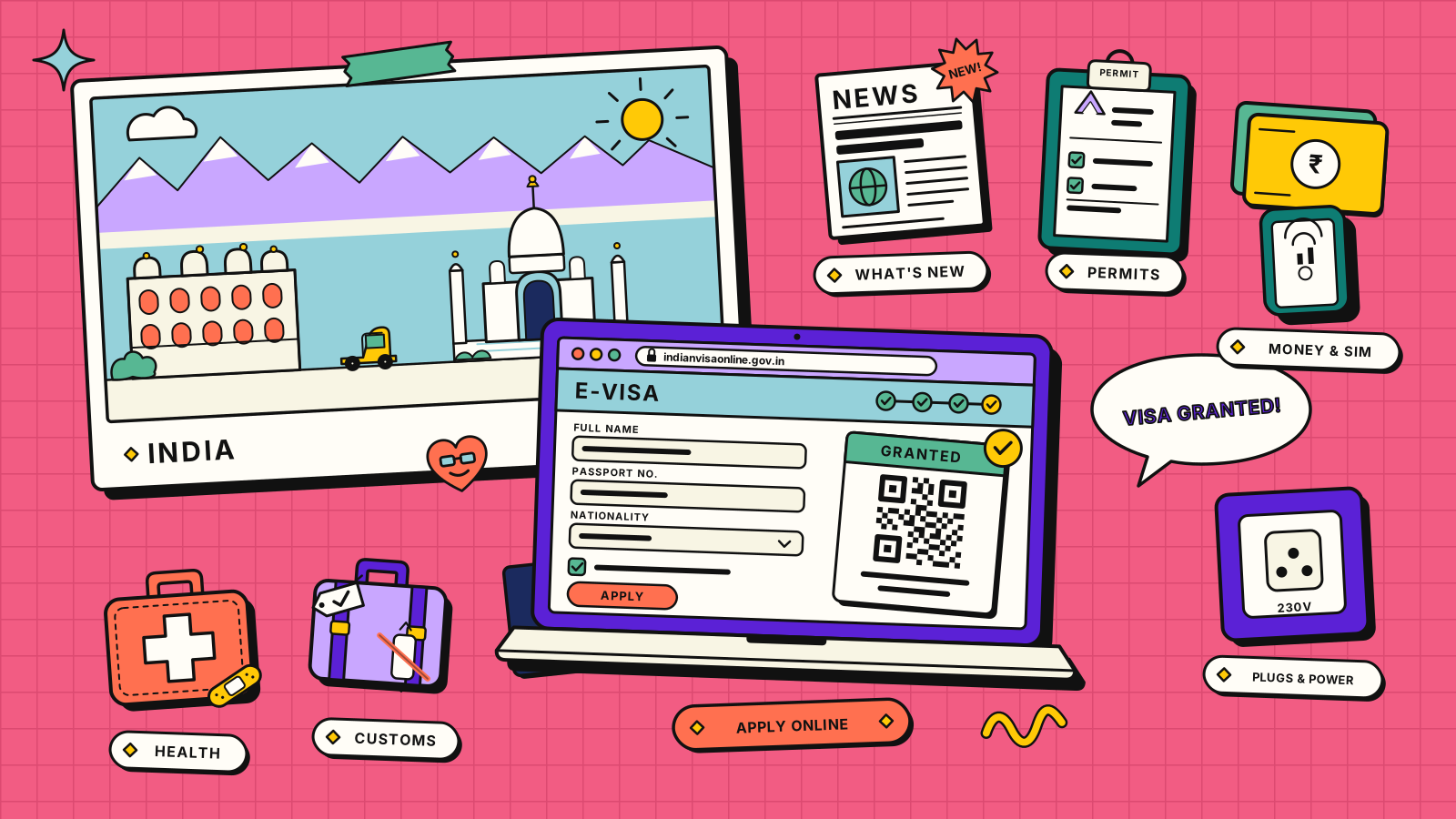
Use the official website only: https://indianvisaonline.gov.in/evisa/. The government's FAQ says no other website takes applications and you don't need an agent. Search results are full of lookalike sites that charge far more for the same form, and some promise faster approval for a fee, which the FAQ specifically warns about.
- Pick your dates. Apply at least 4 days and no more than 120 days before you arrive. Apply on 1 September, for example, and you can pick an arrival date from 5 September to 2 January.
- Fill in the form yourself. Write "NA" in the previous-visa fields if they don't apply.
- Upload your photo. Square JPEG, 10 KB to 1 MB. Full face, eyes open, no glasses, head centred, plain white or light background, no shadows or border.
- Upload your passport bio page as a PDF of 10 KB to 300 KB.
- Add anything else asked for. The official rules say you should hold a return or onward ticket and enough money for your stay, and airlines may ask to see the ticket at check-in.
- Pay by card (Visa or Mastercard) or PayPal. The fee plus 3% is non-refundable.
- Wait for the email, then check the status on the site says "GRANTED" before you fly. There's no official processing time. Guides often quote 72 hours; we'd apply one to two weeks ahead.
- Print the ETA. Check your name, passport number, date of birth and nationality match your passport.
There's nothing to pay at the airport, and anyone asking for an "extra payment" is running a scam. Your fingerprints and photo are taken at immigration on arrival. For questions about your application, the e-Visa Support Centre is on +91 11 24300666 or indian-evisa@gov.in. For payment problems there are toll-free lines in the US (1855 205 5577), UK (0808 178 5040) and Australia (1800 153 861).
Regular visa. Needed for stays over 180 days a year, military or police backgrounds and overland entry. You fill in the form on the same site, then submit it through the mission's partner: VFS Global in the UK, US and Australia, and BLS International in Canada and Spain. In New Zealand, Ireland, Germany, the Netherlands, France, Italy and Sweden you apply at the Indian embassy or high commission itself. Check your mission's website before you book an appointment.
Where you can enter India on an e-visa
The official list has 36 airports, including Delhi, Mumbai, Navi Mumbai, both Goa airports (Dabolim and Mopa), Bengaluru, Chennai, Kolkata, Jaipur, Varanasi and Port Blair. The FAQ on the same page still says 33, but the 36-airport list is the newer one.
- Leh is not an entry point. It's domestic only, so for Ladakh you enter at Delhi or another listed airport and fly on.
- Land borders are unclear. Some crossings appear on the list, but the FAQ says e-visa holders may only enter at airports and seaports. Coming overland from Nepal or Bangladesh, get a regular visa or ask an Indian embassy first. The Wagah-Attari crossing with Pakistan is closed.
You can leave from any authorised immigration checkpoint.
e-Arrival card and health declaration
e-Arrival card (mandatory since 1 April 2026)
The e-Arrival card replaced the paper landing card. It launched on 1 October 2025 and became the only option on 1 April 2026. Every foreign national needs one, OCI cardholders included.
- Wait until you're within 72 hours of arrival. The official page says to submit it within the 72 hours before you arrive, not earlier.
- Use indianvisaonline.gov.in/earrival, boi.gov.in or the "Indian Visa Su-Swagatam" app, the only official channels.
- Fill in your details: name, nationality, passport number, purpose of visit, arrival date, countries visited in the last 6 days, your address in India, email, phone number and an emergency contact. You can add travel companions to the same form.
- Download the confirmation and keep it on your phone.
It's free. Any site charging for it isn't official.
Air Suvidha health self-declaration (mandatory since early July 2026)
After the WHO declared an Ebola outbreak a global health emergency on 17 May 2026, India brought back the Air Suvidha portal as Air Suvidha 2.0. Every international arrival must file a health self-declaration. Reports give different start dates, from late June to the portal's relaunch on 1 July, but it is in force now.
- Up to 24 hours before you arrive, and before you board, go to https://airsuvidha.civilaviation.gov.in/.
- Enter your travel history for the past 21 days and answer the symptom questions.
- Keep the acknowledgement you're sent. The US Embassy says you must show it to immigration on arrival.
The UK and Irish governments both list the form as mandatory (read again on 6 October 2026), and the FCDO says to expect delays if you arrive without it. Temperature checks can happen on arrival, and travellers with symptoms may be isolated or quarantined.
Passport rules and what's checked at the border
| What | Rule |
|---|---|
| Passport validity | At least 6 months beyond arrival (the e-visa site counts from the application date, so use arrival to be safe) |
| Blank pages | 2 |
| Visa | Printed e-visa ETA, paper visa or OCI |
| e-Arrival card | Confirmation on your phone, filed up to 72 hours before arrival |
| Health declaration | Air Suvidha acknowledgement, filed up to 24 hours before arrival |
| Yellow fever | Certificate needed if you arrive within 6 days of leaving a yellow fever risk country |
| Polio vaccine | Certificate needed if you arrive from a polio-affected country (FCDO) |
| Registration | Not needed for tourists staying 180 days or less. Hotels register you automatically. For longer stays, the FCDO says to register with the Foreigners Regional Registration Office within 14 days of arrival |
Since the Immigration and Foreigners Act 2025 took effect on 1 September 2025, hotels and hostels must report foreign guests within 24 hours, so expect to show your passport and visa at check-in. Make sure the officer stamps your passport when you arrive, because it's checked when you leave.
Overstaying. It's a criminal offence. Section 23 of the Immigration and Foreigners Act 2025 allows up to three years in prison, a fine of up to ₹3 lakh, or both. An e-visa can't be extended, so leave before it expires. The FCDO says British travellers who overstayed have found it hard to get accommodation.
Permits for Ladakh, Spiti, Andaman, Sikkim and Nagaland
An e-visa isn't valid in India's Protected and Restricted Areas or cantonments, and some of the most popular trips go through them. Permits are issued electronically through the e-FRRO portal (indianfrro.gov.in) and no physical permits are handed out. They are generally issued to groups of two or more, sponsored by a registered travel agency, for a set route. Citizens of Afghanistan, China and Pakistan, and foreign nationals of Pakistani origin, need prior approval from the Ministry of Home Affairs, so allow much more time. Carry several photocopies for checkpoints. The FCDO suggests applying 3 months ahead.
| Region | Permit | What the official sources say | Check before you go |
|---|---|---|---|
| Ladakh (Nubra, Pangong, Tso Moriri, Khardung La, Turtuk) | Protected Area Permit | Valid for up to 7 days, for groups of two or more through a registered travel agency, applied for via lahdclehpermit.in. Environment, Red Cross and wildlife fees are paid online. Pangong is open as far as Spangmik, Man and Merak | Fees change, so ask your agent for the total. Hanle, Umling La, Chushul and Pangong's south bank are not on the government's list of places open to foreigners |
| Spiti and Kinnaur | Protected Area Permit / Inner Line Permit | Needed for Nako, Pooh, Dhankar and Tabo. Valid for 30 days, ₹200 plus agency charges, for groups of two or more sponsored by a travel agency. Issued by district offices including Reckong Peo, Pooh, Kalpa and Kaza | The Kinnaur district says Kaza needs no permit, but the Lahaul and Spiti district lists Kaza as protected and asks for groups of four. Solo applications are at the officer's discretion |
| Andaman Islands | Restricted Area Permit (mostly not needed now) | 29 islands, including Havelock (Swaraj Dweep) and Neil (Shaheed Dweep), need no permit; 11 more allow day visits until 31 December 2027. Other islands and non-tourist visits still need a permit. The relaxation doesn't apply to citizens of Afghanistan, China or Pakistan, or people of origin in those countries | The 2026 notice sets no maximum stay. Older guides quote 30 days plus 15, so check with the Foreigners Registration Office in Port Blair for long stays |
| Sikkim | Restricted Area Permit | Needed to enter at all. Issued for 30 days and extendable by another 30. Permits are now issued electronically (apply on e-FRRO after you arrive in India and before you enter Sikkim). Tsomgo Lake is a one-day permit and North Sikkim 3 to 5 days, both for groups of 2+ through a registered agency. Nathu La is for Indian nationals only | Whether there's a fee: the state's page doesn't say |
| Meghalaya | None at present | Foreign visitors need no Inner Line Permit or Protected Area Permit for Meghalaya at present. The state announced a mandatory visitor-registration system in July 2026 that had not launched when last reported | Check the position closer to your trip |
| Nagaland | Protected Area Permit | Re-imposed on 17 December 2024. Apply via e-FRRO and register locally within 24 hours of arriving. Eased for the 2025 Hornbill Festival | No relaxation for Hornbill 2026 had been announced by 24 September 2026. Last year's was announced in late November |
Manipur and Mizoram are also under the permit regime, and Arunachal Pradesh and parts of Uttarakhand need permits too. Permit rules can change at any time, so check the current rule before you book. More detail in our guides to Ladakh, Spiti, the Andaman Islands and the Hornbill Festival.
Health
This is a summary of CDC and TravelHealthPro advice. A travel clinic can tell you what fits your own trip.
- Vaccines: routine vaccines plus hepatitis A and typhoid for most travellers. Hepatitis B, rabies, Japanese encephalitis and cholera depend on your trip.
- Yellow fever: India isn't a risk country, but you need a certificate (the original) if you arrive within 6 days of leaving one, from age 9 months.
- Malaria: the CDC says there's risk throughout India, including Delhi and Mumbai, but none above 2,000 m. TravelHealthPro rates most areas, including Goa and the Andamans, as low risk where bite avoidance is enough. The two differ, so ask a clinic.
- Air pollution: severe in northern cities from October to February.
- Food, water and drinks: bottled or filtered water, hot fresh food. The FCDO warns about drink spiking and methanol in alcohol.
- Altitude: Leh sits at 3,514 m. Above 3,000 m there's no commercial rescue, and military rescue isn't guaranteed. Your insurance should cover altitude above 2,400 m, mountain rescue, treatment and evacuation.
- Medicines: original packaging and a prescription letter. For narcotic or psychotropic medicines (strong painkillers, some sleeping pills and ADHD drugs), India's Department of Revenue says to get permission from the Narcotics Commissioner before you leave home.
Customs and what not to bring
- Satellite phones and GPS devices. Illegal without a Department of Telecommunications licence, even in transit. Tourists have been arrested, including a US national at Srinagar airport in April 2026. The FCDO says the rule also covers other satellite-enabled devices, including handheld GPS units. No official list names the Garmin inReach, but travellers carrying satellite messengers have been detained, so leave them at home.
- Drones. Foreign-made drone imports are banned, and flying needs Indian registration and an Indian pilot certificate. Don't bring one.
- Vapes and e-cigarettes. Banned. You can't bring them in or buy them.
- Indian rupees. Foreign visitors may bring in up to ₹25,000 in rupee notes, but only when arriving at an airport (and not if you're a Pakistani or Bangladeshi national). Anything above that isn't allowed, so change the rest after you land.
- Foreign currency. Declare more than US$5,000 in notes, or US$10,000 in total.
- Duty free. Since 2 February 2026, ₹25,000 of new goods, 2 litres of alcohol and 100 cigarettes.
- Alcohol and drugs. Bihar, Gujarat, Mizoram, Nagaland and Lakshadweep are dry. Drug sentences start at 6 months.
Money, SIM cards and plugs
Money. Visitors can use UPI, India's QR-code payment system, through UPI One World: a prepaid wallet set up in an app such as CheqUPI with your passport and visa, loaded from a foreign card. You don't need an Indian bank account or number, and unused money is refunded. Load limits are set by the app provider, so check them before you rely on it for a whole trip. Change cash at the airport or at authorised money changers. The FCDO says you can withdraw rupees with a bank card, and warns that card skimming is common, so use ATMs inside banks or shops where you can.
SIM cards. Airtel sells SIMs at Delhi's Terminal 3. Bring your passport and visa, plus a passport photo and your hotel address for the paperwork. Activation isn't instant, so a data-only travel eSIM bought at home is simpler.
Plugs. Type C, D and M sockets (D, with three round pins, is most common) at 230 V. Anything rated 100-240 V needs only an adaptor; 110 V-only devices need a converter.
See our India packing list.
Safety advisories
None of the governments we checked advises against travel to India as a whole. The UK, Ireland and Canada rows below are as we last read them between 24 September and 6 October 2026. The US and Australian governments publish their own ratings, so check each government's page before you book.
| Government | Overall level | Areas to avoid |
|---|---|---|
| UK (FCDO) | No whole-country warning | All travel within 10 km of the Pakistan border and to Jammu and Kashmir (except flying into Jammu city). All but essential travel to Manipur |
| US (State Department) | Publishes its own level, so check the current advice | Names regions to avoid, including Jammu and Kashmir and the area near the Pakistan border |
| Australia (Smartraveller) | Publishes its own level, so check the current advice | Names regions to avoid, including Jammu and Kashmir and the India-Pakistan border |
| Ireland (DFA) | High degree of caution (level 2 of 4) | All travel to Jammu and Kashmir, Tripura and Manipur outside Imphal. All but essential travel to Imphal |
| Canada | Exercise a high degree of caution, with regional advisories | All travel to Jammu and Kashmir and within 10 km of the Pakistan border. Non-essential travel to Manipur |
Ladakh isn't covered by the Jammu and Kashmir warning, but the Srinagar-Leh road is, so fly into Leh or use the Manali-Leh road.
Student protests at Jantar Mantar in Delhi ran from June to late July 2026 and spread to Mumbai, Bengaluru and other cities. They were called off on 25 July. Mumbai police banned large gatherings for two weeks afterwards, but there was no curfew. Germany's foreign office says smaller student protests still flare up in places, so avoid demonstrations.
The FCDO and Irish DFA both report harassment of women. The FCDO advises against hailing taxis alone at night; use Uber, Ola, prepaid taxis or hotel transfers. More in our guide to staying safe in India as a solo traveller.
Timeline of recent changes
| Date | What changed |
|---|---|
| Aug 2021 | e-visas withdrawn for UK nationals |
| 5 Dec 2022 | e-visas restored for UK nationals |
| Sep-Nov 2023 | Visa services suspended for Canadians, then e-visas resumed on 22 Nov 2023 |
| 17 Dec 2024 | Permit regime re-imposed on Nagaland, Manipur and Mizoram |
| Apr 2025 | Pakistan closes its airspace to Indian airlines (still in force) |
| 1 Sep 2025 | Immigration and Foreigners Act 2025 in force |
| 1 Oct 2025 | e-Arrival card launched |
| 23 Dec 2025 | 5-year e-Tourist visa fee rises to US$200 (US$160 for Americans, US$484 for UK passports) |
| Jan 2026 | Sikkim permits move online only |
| 2 Feb 2026 | Baggage Rules 2026: tourist duty-free allowance rises to ₹25,000 |
| 28 Feb 2026 | Middle East airspace closures cause mass flight cancellations |
| 5 Mar 2026 | Andaman permit exemptions published, valid to 31 Dec 2027 |
| 1 Apr 2026 | Paper arrival card abolished; e-Arrival card mandatory |
| Jun to Jul 2026 | e-OCI launched; new OCI cards digital only from 8 Jul |
| Late Jun to early Jul 2026 | Air Suvidha 2.0 health declaration mandatory for all arrivals (sources differ on the exact day) |
Travel with us
We run small group trips in India for solo travellers aged 18 to 40, and I host every one as your Trip Host. Start with the India Golden Triangle (7 days), or go deeper with India Rajasthan & Varanasi (14 days) and India North to South (21 days). For mountains, beaches or islands, see the Ladakh Road Trip, Spiti Valley Road Trip, South India Goa to Kerala and Andaman Islands Beach Tour. See all India group trips.
Keep planning
- India travel guide
- Best time to visit India
- Is India safe for solo travellers?
- India packing list
- India visa by passport: UK · US · Australia · Canada · Europe