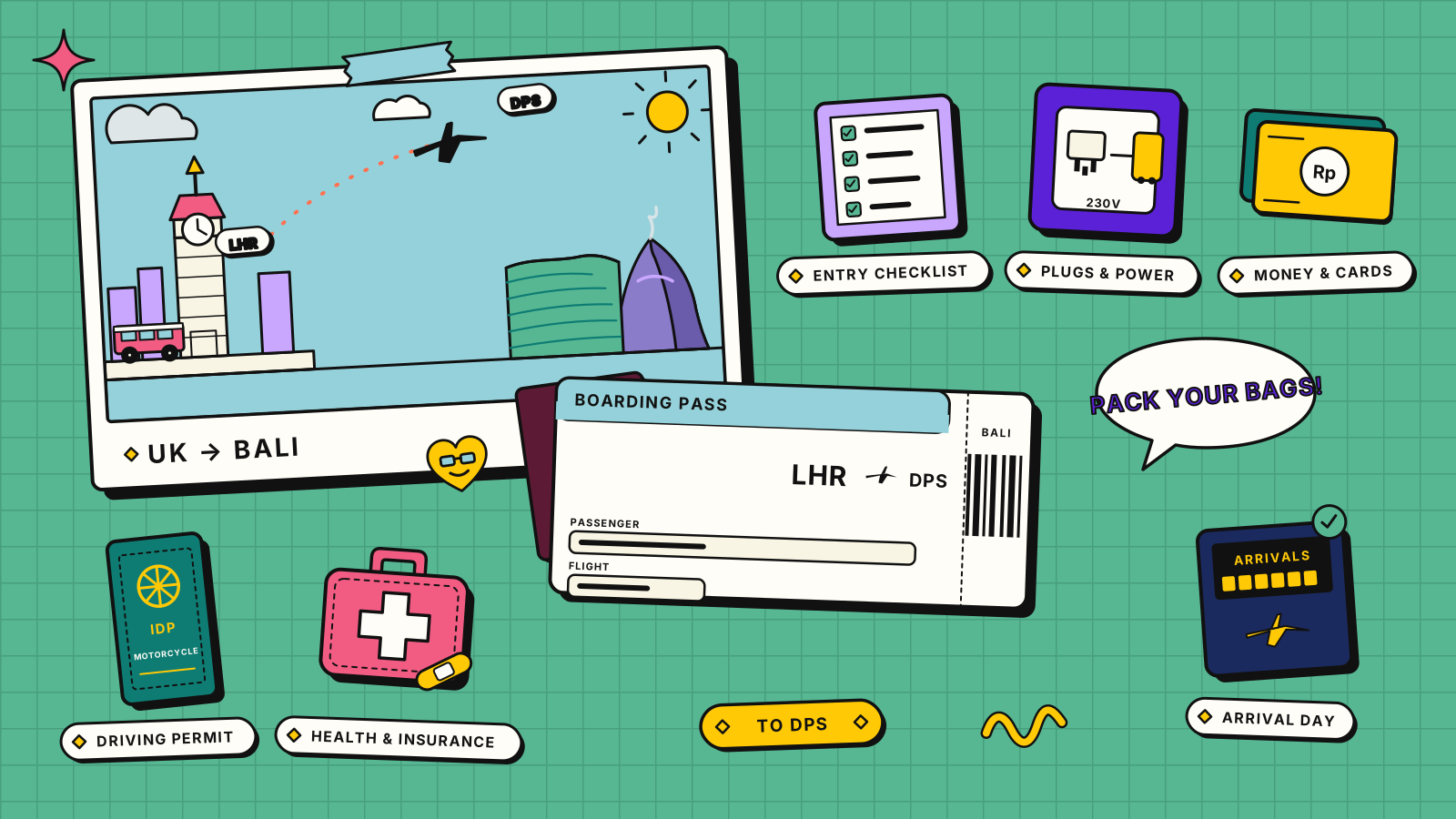
Indonesia changes these rules often and with little warning, so check the official portals before you pay for anything. The country pages cover flights and packing for your passport:
- Bali from Australia
- Bali from the UK
- Bali from the US
- Bali from Europe (Germany, Netherlands, Ireland, France, Spain, Italy, Sweden)
- Bali from India
Visa rules by nationality
All 13 nationalities below are among the 87 that get the Visa on Arrival (index B1, formerly B2). The 30 days can be extended once, by another 30.
| Passport | Visa needed | Fee | Stay |
|---|---|---|---|
| United Kingdom | e-VOA or VOA | IDR 500,000 | 30 days |
| United States | e-VOA or VOA | IDR 500,000 | 30 days |
| Canada | e-VOA or VOA | IDR 500,000 | 30 days |
| Australia | e-VOA or VOA | IDR 500,000 | 30 days |
| New Zealand | e-VOA or VOA | IDR 500,000 | 30 days |
| Ireland | e-VOA or VOA | IDR 500,000 | 30 days |
| Germany | e-VOA or VOA | IDR 500,000 | 30 days |
| France | e-VOA or VOA | IDR 500,000 | 30 days |
| Netherlands | e-VOA or VOA | IDR 500,000 | 30 days |
| Spain | e-VOA or VOA | IDR 500,000 | 30 days |
| Italy | e-VOA or VOA | IDR 500,000 | 30 days |
| Sweden | e-VOA or VOA | IDR 500,000 | 30 days |
| India | e-VOA or VOA | IDR 500,000 | 30 days |
All 13 passports above appear on the list of 87 eligible countries at evisa.imigrasi.go.id, as of 6 October 2026. (The portal spells the Netherlands "Netherland".)
Fee rise announced. On 12 August 2026 the Director General of Immigration announced IDR 750,000 for an e-VOA bought before travel and IDR 1,000,000 for a VOA bought on arrival (RRI, The Star). Reports disagree on whether it is already in force, and neither gives a start date. The official e-VOA page still listed IDR 500,000 when we opened it on 6 October 2026, so this page uses that figure. Check the portal for the current fee before you pay.
Visa-free entry (index A1) is mostly for ASEAN passports. The VOA is for tourism, meetings, family visits and transit. It doesn't allow work, and the FCDO warns that working on a tourist visa can lead to prosecution and detention. That includes paid content creation and teaching yoga or surfing. Overstaying costs IDR 1,000,000 a day, and you can be deported.
How to apply for the e-VOA, step by step
The e-VOA costs the same as the airport VOA. The difference is that you skip the payment queue, and at Bali and Jakarta airports you can use the automated immigration gates. Indonesian Immigration says foreign visitors can use the autogates if they hold an e-VOA (or another e-visa) and an electronic passport, the kind with a chip symbol on the cover. There's no nationality restriction. If you buy your VOA at the airport, or your passport has no chip, you go to the desks.
Apply only on evisa.imigrasi.go.id. Before you type in passport or card details, check that the address ends in .go.id: there are lookalike sites, and the FCDO says visa scams are on the rise.
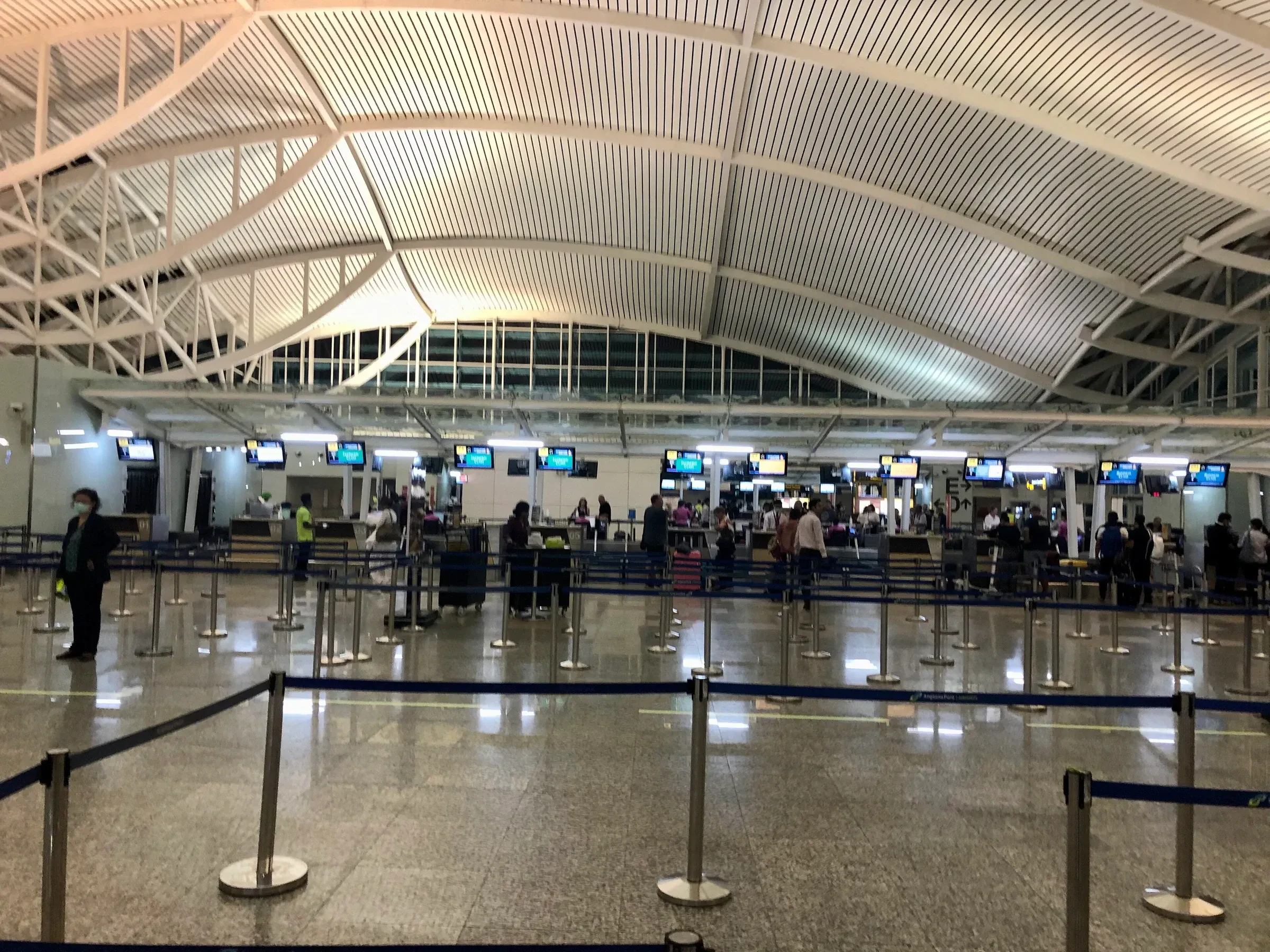
- Go to https://evisa.imigrasi.go.id and register an account. Verify your email within one hour.
- Upload a scan of your passport photo page and a passport-style photo. Both must be JPG, JPEG or PNG and no larger than 200 KB. Your passport needs 6 months' validity.
- Choose the Visitor Visa / e-VOA and enter your arrival date, port of entry (Bali is DPS) and flight.
- Pay IDR 500,000 by Visa, Mastercard or JCB within 120 minutes of starting. The card doesn't have to be in your name. Your bank may add a foreign transaction fee, and 3-D Secure is reportedly required.
- Download the approved visa PDF. Keep one copy offline on your phone and one printed.
On timing: you can apply up to 14 days before travel, and the portal asks for at least 48 hours before departure. The official tourism board quotes 3-5 working days for visitor visas, though e-VOAs often come through much faster. The FCDO suggests a week ahead for e-visas, and that's the safer plan.
The visa is single entry and valid for 90 days from issue. Your 30 days start when you land. Everyone needs their own, children included. Check your details carefully, because you can't change them after submitting, a mismatch with your passport makes the visa invalid, and there are no refunds.
If you'd rather buy it at the airport, the VOA counter takes cash or card, and you'll need to show proof of onward travel.
Extending your stay
You can extend a VOA once, for another 30 days, giving 60 days in total. Officially this is an extension of your stay permit, not a new visa.
The online route, as described by the Yogyakarta immigration office:
- Log in at evisa.imigrasi.go.id and go to Services, then Find Existing Stay Permit, Input Data, Action, Extend.
- Pay IDR 500,000.
- You then visit an immigration office for a photo and a short interview, from one working day after paying. The office is assigned by the postal code you enter.
Some older guides say e-VOA holders can extend entirely online, but that's no longer true. Since 29 May 2025, Indonesian Immigration has required every foreigner extending a stay permit, VOA holders included, to go to an immigration office for the photo and interview. Only elderly, disabled, pregnant or breastfeeding applicants and urgent cases get walk-in help to do the whole thing at the office. Immigration doesn't publish a lead time, but the extension has to be done before your 30 days run out, so I'd start 7 to 14 days before day 30.
Staying longer: the C1 visa
For more than 60 days, apply online before you travel for the C1 Single-Entry Visit Visa, which replaced the tourist side of the old B211A.
- Stay: 60 days, extendable twice by 60 days, up to 180 days.
- Government fee: the official portal lists IDR 1,000,000, although another line on the same page says IDR 1,500,000, so check the total before you pay. Agencies charge much more.
- Documents: passport with 6 months' validity, a recent colour photo and a personal bank statement for the last 3 months showing at least US$2,000 or the equivalent. The official portal states this requirement itself, so it isn't just something from news reports.
- Extensions start online, then need an office visit for biometrics and an interview.
Frequent visitors can look at the multiple-entry D1 tourist visa, which the portal offers in 1-, 2- and 5-year versions with up to 60 days per visit. The 1-year version costs IDR 3,000,000 and also needs the US$2,000 proof of funds.
The All Indonesia arrival card
Since 1 October 2025, everyone arriving in Indonesia from abroad, at airports and seaports alike, has to complete the free All Indonesia declaration. It replaced the old customs form and the SATUSEHAT health pass, and covers immigration, customs, health and quarantine in one go.
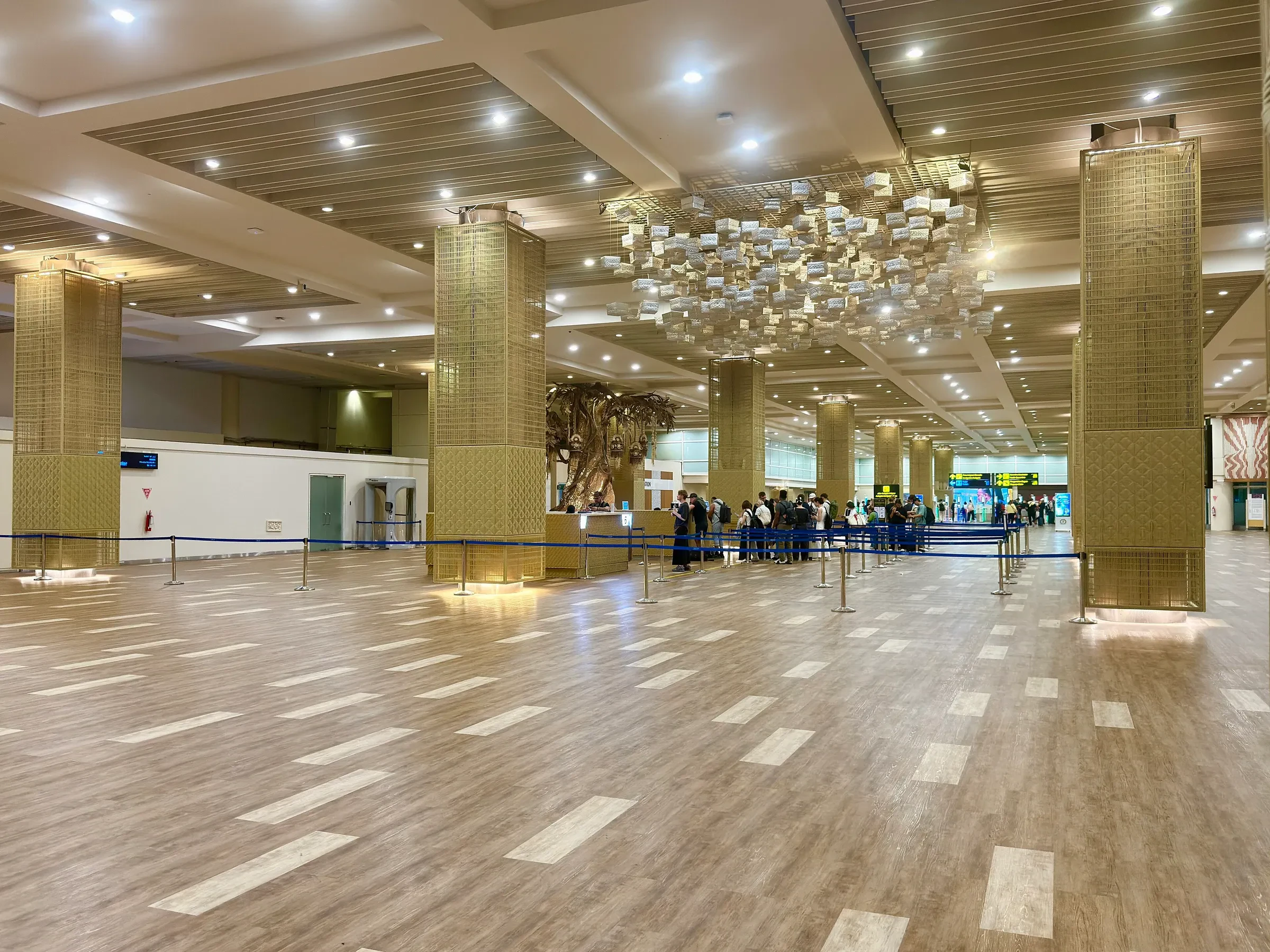
- Within 72 hours before you land (the portal won't accept earlier dates), go to https://allindonesia.imigrasi.go.id or download the official All Indonesia app.
- Pick your arrival date and enter your name, nationality, date of birth and passport number exactly as in your passport.
- Add your flight and your address in Indonesia, then answer the health questions.
- Complete the customs section: goods, cash of IDR 100 million or more, and restricted items such as medicines.
- Submit. Save the emailed QR code, which you show at immigration and customs.
Each traveller submits their own, children included. If you forget, you can reportedly do it at the airport via a QR code, but expect delays. The form is free, so if a site asks for money, it's a scam. It also doesn't cover the Bali levy.
The Bali tourist levy
Every foreign tourist entering Bali pays IDR 150,000 (roughly AUD 12, GBP 6, EUR 7 or US$8 at September 2026 exchange rates). The levy started on 14 February 2024 and now sits under Bali Provincial Regulation No. 2 of 2025.
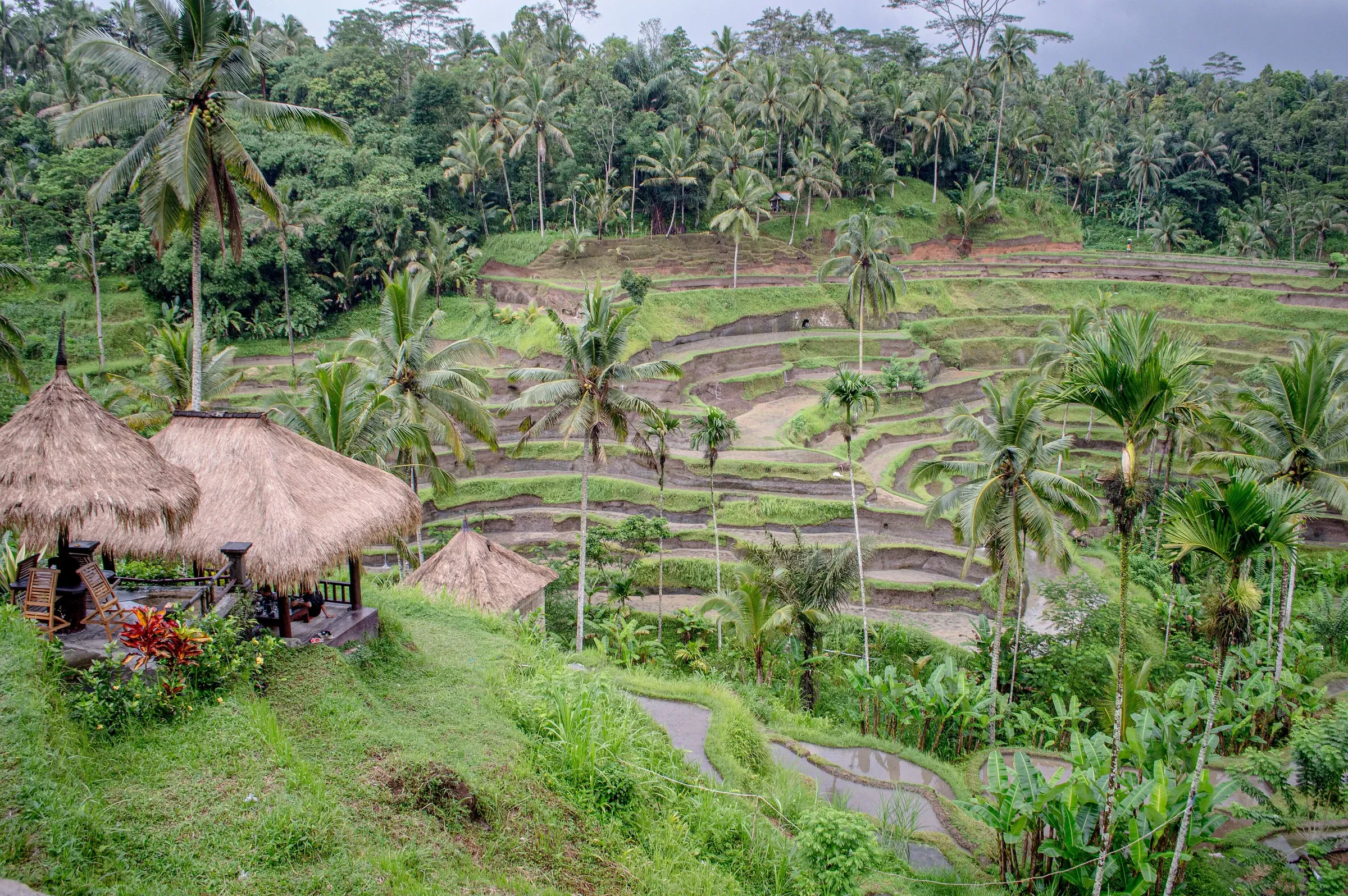
To pay:
- Go to lovebali.baliprov.go.id or the Love Bali app. Check for .baliprov.go.id, because many lookalike sites exist.
- Choose Single or Group and enter your arrival date and passport details.
- Pay by card, bank transfer, virtual account or QRIS, and save the emailed voucher QR code.
If online payment fails, the official FAQ says you can pay at the payment counters at Bali's airport and ports.
Satpol PP officers are running spot checks in 2026 at Uluwatu, Tanah Lot, Besakih, Tegallalang, the airport and the Nusa Penida crossings. No QR code means paying on the spot.
KITAS and KITAP holders don't pay. Other non-tourist visa holders can apply for an exemption at least 5 days before arrival. The official FAQ says the levy is paid once while you're travelling in Bali, before you leave Indonesia. It doesn't spell out what happens on a side trip to Lombok or the Gilis and back, so ask Love Bali if that's in your plans. A rise to IDR 300,000 or more has been floated, but nothing is signed for 2026.
Passport and onward ticket
Your passport must be undamaged and valid for 6 months from arrival. Have 2 blank pages; Canada's advice says 1, but UK and US advice says 2. The VOA also requires proof of an onward or return journey, and airlines may ask for it at check-in.
Bali's behaviour rules and the 2026 criminal code
The Governor of Bali's Circular No. 7 of 2025 (March 2025) lists dos and don'ts for visitors.
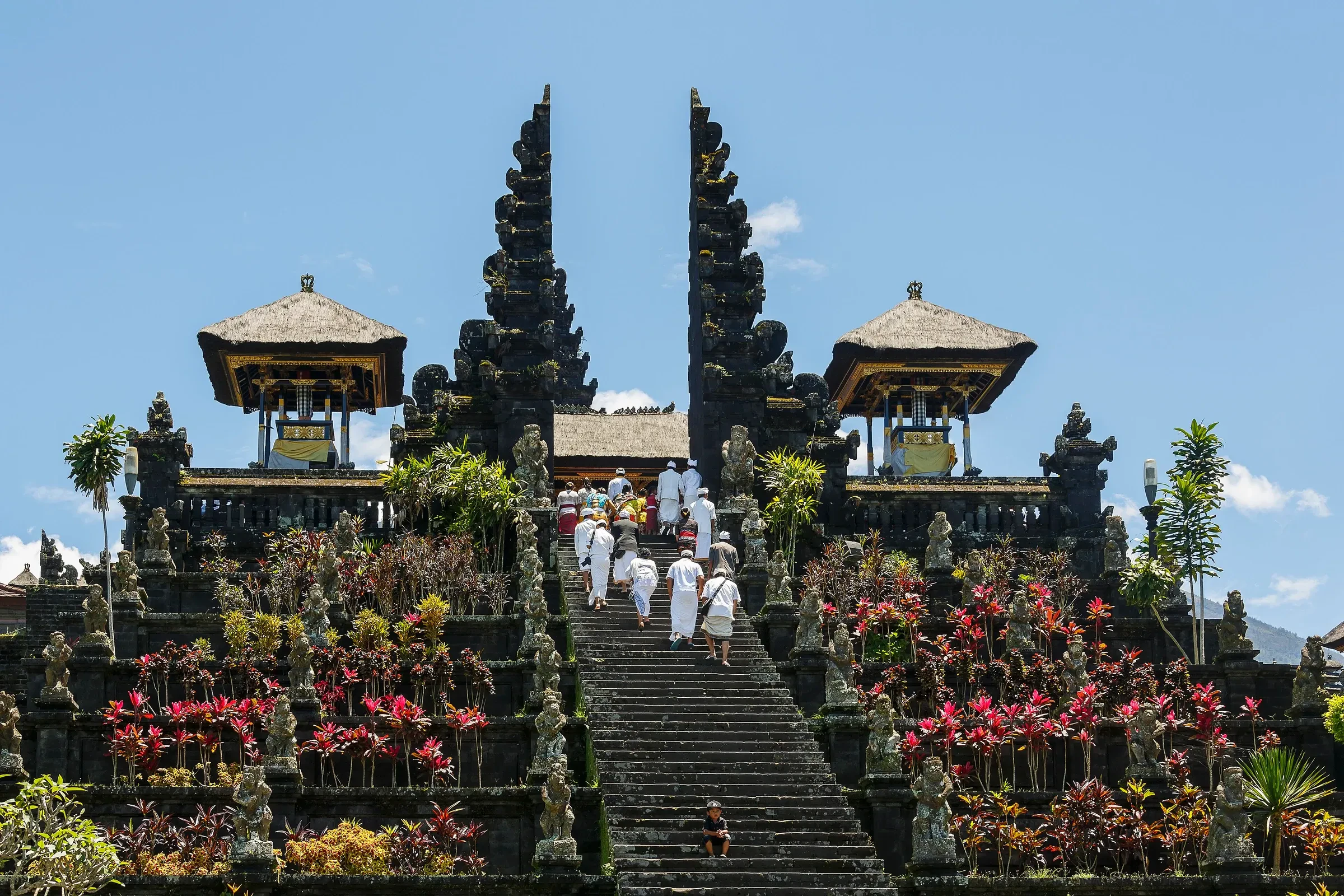
The dos: respect temples, dress modestly at sacred sites and in public, pay the levy, use licensed guides at attractions and licensed money changers, pay in rupiah (cash or QRIS), ride with a valid licence and stay in licensed accommodation.
The don'ts: don't enter a temple's main and middle sanctums (utama and madya mandala) unless you're praying in traditional dress. Don't climb sacred trees or structures or take indecent photos at sacred sites. Don't litter or use single-use plastics, cause disturbances, or work without the right documents.
Penalties range from fines to deportation, blacklisting or prosecution, and there's a tip-off hotline on +62 812-8759-0999.
If you stay in a private home rather than a licensed hotel, you must register with the local police (fine up to IDR 5 million). On Nyepi, the Day of Silence each March, the island shuts for 24 hours, airport included, and you stay indoors with no lights or noise. See Nyepi dates.
Indonesia's new Criminal Code (KUHP) took effect in January 2026. Sex outside marriage carries up to a year in prison, and cohabitation by unmarried couples up to 6 months. Foreigners are covered too, but only a spouse, parent or child can bring a complaint, and hotels don't have to check whether guests are married. The FCDO describes the risk to tourists as complaint-based. The code also covers insulting the President or state institutions, spreading "false news", blasphemy and holding protests without notice.
Riding a scooter: licence rules
Bali announced a ban on tourists renting scooters in 2023, but it never came into force. If you rent, use a licensed business.
Riding legally takes your home licence plus an International Driving Permit with the motorcycle (A) category. The FCDO says a UK licence on its own isn't valid. Police checks focus on foreigners, and insurers often won't pay out if you were riding unlicensed. The FCDO also reports a big rise in moped accidents in Bali, some of them fatal.
Nusa Penida's roads are steep and broken up, so plenty of travellers hire a car with a driver there instead. On the Gilis there are no motorised vehicles at all.
Health
- Most travellers need hepatitis A, typhoid and hepatitis B on top of routine vaccines. See a clinic 4-8 weeks ahead. You only need a yellow fever certificate if you arrive from a country with transmission risk.
- Bali has rabies, and temple monkeys and street dogs do bite. Get treatment straight away after any bite or scratch.
- Dengue is common, especially from November to April. TravelHealthPro rates malaria risk as low in Bali, with a high risk in Papua; ask a clinic before going to Flores or Komodo.
- On 7 August 2026 the US CDC issued a Level 2 travel health notice for Zika in Indonesia after cases in travellers returning from Bali, and advises pregnant travellers to avoid travel to Bali. Bali's provincial health agency said on 23 August 2026 that it had no reported cases. TravelHealthPro advises women to avoid becoming pregnant for 2 months after the last possible exposure. Ask a travel clinic what this means for you.
- Methanol in counterfeit spirits and arak has killed people, so skip cheap cocktails and home-made arak. Drink spiking has also been reported.
- Medical evacuation can cost tens of thousands of pounds. Check your insurance covers scooters (with a licence), diving and volcano treks.
- On 18 September 2026 the FCDO dropped its advice against all travel to Indonesia's volcanoes. Stick to the local exclusion zones on Agung, Batur and Rinjani.
Customs and what not to bring
- Drugs: penalties include long prison terms and the death penalty. All cannabis is illegal, including CBD oil, edibles and THC or CBD vape liquid.
- Duty-free (per adult): 1 litre of alcohol (21 and over); 200 cigarettes, 25 cigars or 100 g of tobacco; personal goods bought abroad up to US$500. Customs destroys anything over the alcohol and tobacco limits.
- Cash: declare IDR 100 million or more, or the same in foreign currency.
- Medicines: original packaging, a prescription copy and a doctor's letter giving the medicine, dose and diagnosis. Indonesia's food and drug agency (BPOM) allows up to 90 days' supply of prescription medicine. Psychotropic medicines, such as benzodiazepines, are allowed for foreign visitors only, with a prescription, up to 60 days' supply. Narcotics can't be brought in at all, and Indonesia classes strong opioids and amphetamine (the active ingredient in Adderall) as narcotics. Declare medicines on the arrival card. If you're not sure how your medicine is classed, ask BPOM (was.sas.bbo@pom.go.id) or the Indonesian embassy before you travel.
- Vapes: legal, but customs limits each adult to 30 ml of open-system e-liquid or 12 ml of closed-system pods (or 140 sticks or 40 capsules of solid e-cigarette products). Anything over the limit is destroyed. THC or CBD liquid counts as drugs.
- Drones: drone flying is governed by Transport Ministry Regulation PM 37 of 2020, and the Directorate General of Civil Aviation (DGCA) runs the SIDOPI drone registration system. Some 2026 guides say every drone brought into Bali must be pre-registered, with fines up to IDR 5 billion, but we couldn't confirm that from an official source. Check with the DGCA (hubud.dephub.go.id) before you pack a drone. Either way, keep away from crowds, temples and the airport zone (about 15 km, covering Kuta, Seminyak, Sanur, Jimbaran and Nusa Dua).
- Also restricted: pornography, fresh fruit, meat and plants, and firearms, including imitations.
Money, plugs and SIM cards
- Money: the currency is the Indonesian rupiah (IDR). Pay in rupiah or by QRIS. Use licensed changers with the green "PVA Berizin" sticker. ATMs are scarce on the Gilis, Nusa Penida and remote Flores, so carry cash there, and always choose to be charged in IDR.
- Plugs: Type C and F (two round pins), 230 V. UK, US and Australian travellers need an adaptor.
- SIM cards: tourist SIMs from Telkomsel, XL and Indosat are sold in DPS arrivals and need your passport. Phones on local SIMs must be IMEI-registered; official outlets do this free for up to 90 days. Roaming and foreign eSIMs generally aren't affected.
Our Southeast Asia packing list has the rest.
Fast boats and Komodo
Safety standards vary a lot between boat operators. The FCDO says to check for life jackets and avoid night crossings. There was a capsize off Sanur in August 2025 and a ferry fire between Padang Bai and Lembar on 12 August 2026. Book licensed operators and don't get on an overloaded boat. High swell often cancels sailings, so leave a buffer day before an international flight.
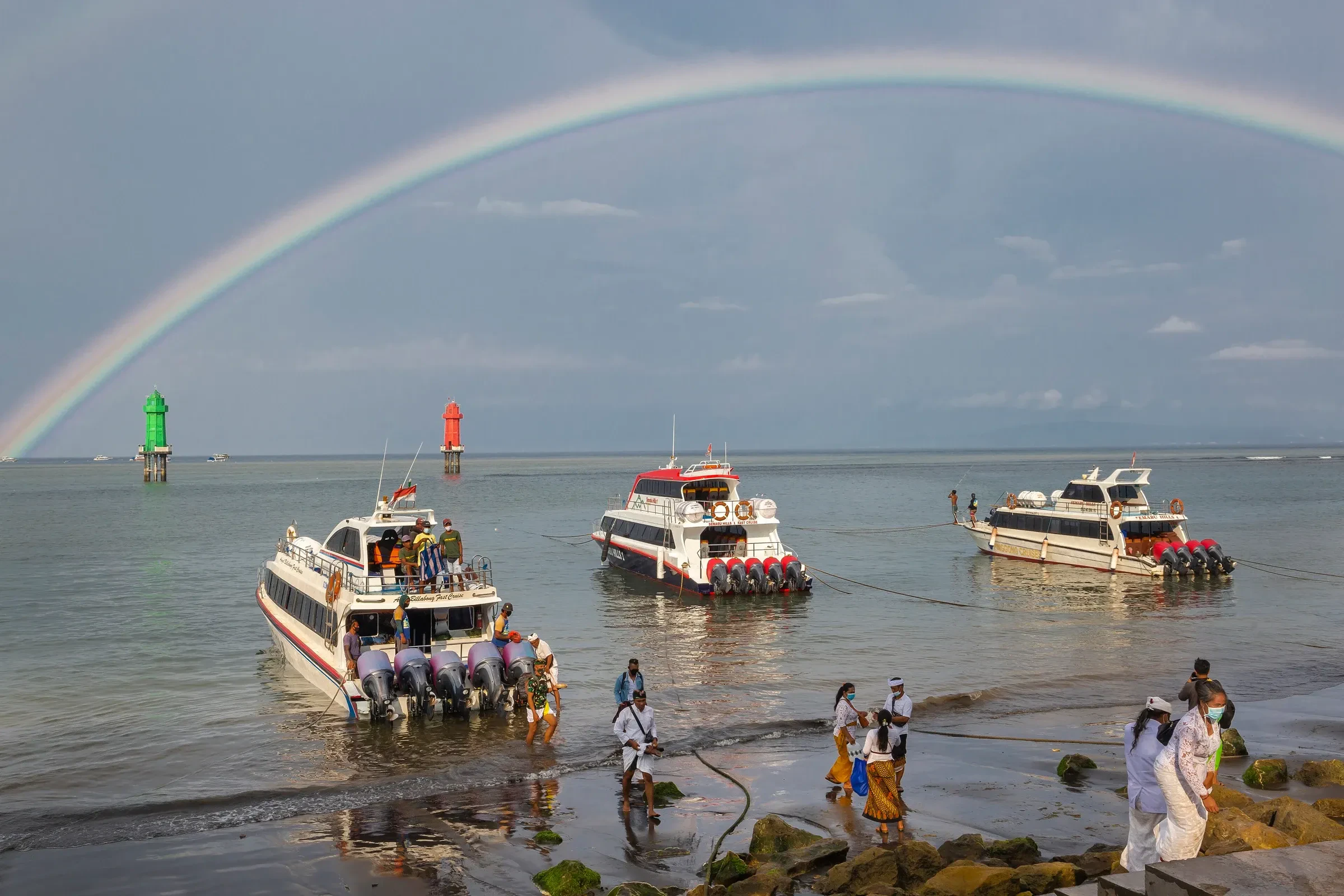
Since 1 April 2026, Komodo National Park has a daily quota of 1,000 visitors, and visits go through a licensed boat operator that registers every visitor on the SiOra system, so arrange it ahead of time. December to February trips risk cancellation: tourist boats from Labuan Bajo were suspended for most of January 2026. More in our Komodo guide.
Recent changes
| Date | What changed |
|---|---|
| 14 Feb 2024 | Bali tourist levy of IDR 150,000 begins |
| 24 Mar 2025 | Governor Circular 7/2025 sets tourist dos and don'ts |
| 29 May 2025 | In-person photo and interview required for every stay permit extension, VOA included |
| Jun 2025 | Visa indices renamed: VOA is now B1, visa-free is A1 |
| 1 Oct 2025 | All Indonesia arrival card mandatory for arrivals from abroad at airports and seaports |
| 2 Jan 2026 | New Criminal Code in force |
| Feb-Jun 2026 | Middle East airspace closures disrupt Gulf-airline flights to Bali; services restored by about mid-June |
| 2026 | Tighter levy spot checks |
| 1 Apr 2026 | Komodo daily quota of 1,000 visitors and mandatory SiOra booking |
| 12 Aug 2026 | Immigration announces a VOA and e-VOA fee rise, start date not confirmed |
| 18 Sep 2026 | FCDO drops advice against all travel to Indonesia's volcanoes |
Travel Bali with a small group
Solo travellers aged 18 to 40, with me as your Trip Host and a licensed local guide.